


What Kind of Company Is BRAZNEX?
BRAZNEX is trying very hard to present itself as a large, sophisticated, and fully compliant global platform.
Open its website and you are immediately hit with a polished set of buzzwords: “multi-asset trading ecosystem,” “AI-native intelligence,” “cross-jurisdictional compliance,” and “global investment infrastructure.” The site is also packed with flashy metrics like 150K+ TPS, <1ms latency, 100+ global venues, and 50+ stock exchanges, all designed to make it look like a mature platform that has been operating for years.
But that is exactly where the problem begins. What proves a platform’s identity and credibility is not a pile of slogans or impressive-looking numbers. What matters is who is actually behind it, which company operates it, whether it is genuinely regulated, what license it holds, and whether any of that can be verified in official records. On those key points, BRAZNEX does not provide information that matches the image it is trying to sell.
To put it simply, the most striking thing about BRAZNEX is not how solid its business looks, but how heavily it has been packaged.
This Is Not a Long-Established Platform, but a Brand That Suddenly Appeared in Late February
Based on its public online footprint, the BRAZNEX brand only began appearing in a concentrated way in late February 2026.
Its self-operated blog published its first post on February 25, 2026. On that same day, a branded article about BRAZNEX appeared on TechFinancials. Whois records also show that braznexa.com was registered on February 27, 2026. In other words, as of March 15, 2026, the website had been publicly visible for less than a month.
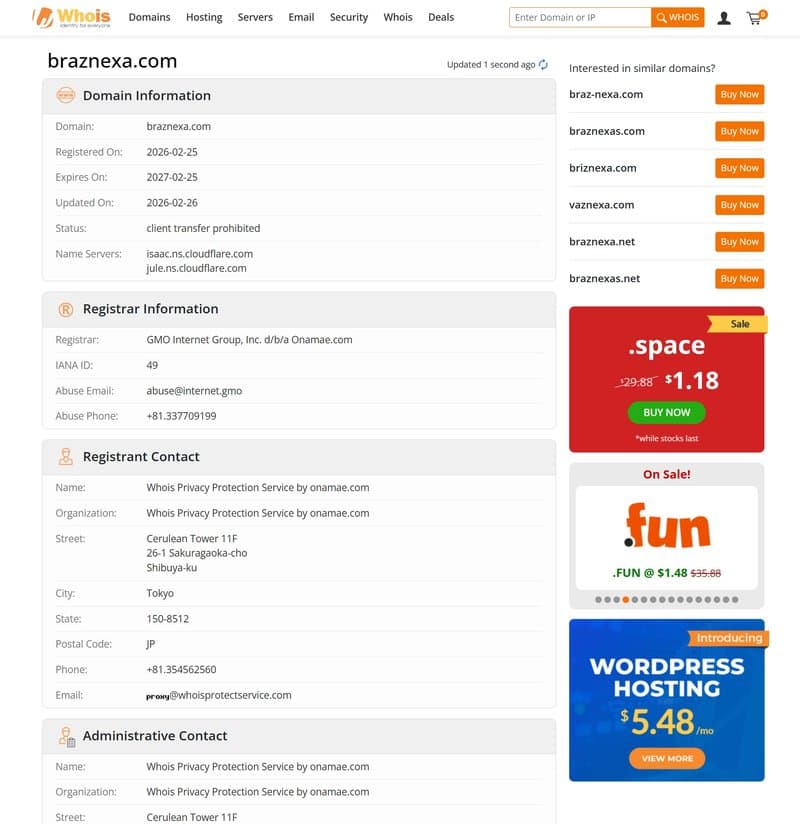
That contrast is hard to ignore. A platform with an extremely short history is presenting itself as a “global multi-asset infrastructure layer.” That alone is a major warning sign.
A normal financial platform builds credibility in the opposite order. First comes a real legal entity, then licenses, then stable products, then a public operating history, and only after that does the brand slowly gain trust. BRAZNEX gives the opposite impression. It first tells a very big story, fills the site with grand language, markets itself as “institutional-grade,” and only then starts building its online footprint. That looks less like a real business growing naturally and more like a brand being built backwards.
The Website Looks Sophisticated, but the Core Information Is Empty
The BRAZNEX website does one thing especially well: it piles on technical language.
It repeatedly talks about “Execution-as-Code,” “Compliance-as-Code,” “AI Decision Support,” “Unified Multi-Asset Ledger,” and “Global Presence.” At first glance, this sounds like an advanced fintech narrative. But when you look more closely, most of it stays at the level of self-praise. The site talks a lot about vision, system design, and future capabilities, but it does not provide the most important information users would actually need to verify the company.
For example, its contact page mainly shows a simple inquiry form, plus claims that the team is distributed across London, New York, Singapore, and Tokyo. It also prominently mentions “multi-jurisdictional licensing” and a “regulatory framework.” Yet the page does not clearly show the full legal name of any licensed entity, does not provide a specific regulatory number, does not link to an official registration database, and does not even give what looks like a proper office address.
This is what makes BRAZNEX feel so awkward.
It is not that the company avoids talking about regulation. In fact, it talks about it constantly. But it talks about regulation more like a marketing theme than as a matter of transparency.
The Team Looks More Like a Set of Personas Than a Real Executive Lineup
When a platform is real, it is usually not hard to find out who its executives are.
Especially if a company truly does what BRAZNEX claims to do — global multi-asset infrastructure, institutional execution, cross-border compliance, and AI-supported trading — then its CEO, CTO, risk officers, and quantitative leads should normally have long professional histories, public career records, interviews, previous roles, and at least some traceable information that can be cross-checked.
But one of the strangest things about BRAZNEX is that the easiest places to find information about its “executives” are still its own blog, its own website, and the promotional content it pushed out itself. For example, the name Cassian V. Alder, listed as CEO, appears most visibly in BRAZNEX’s own blog materials and in its own press-style article.
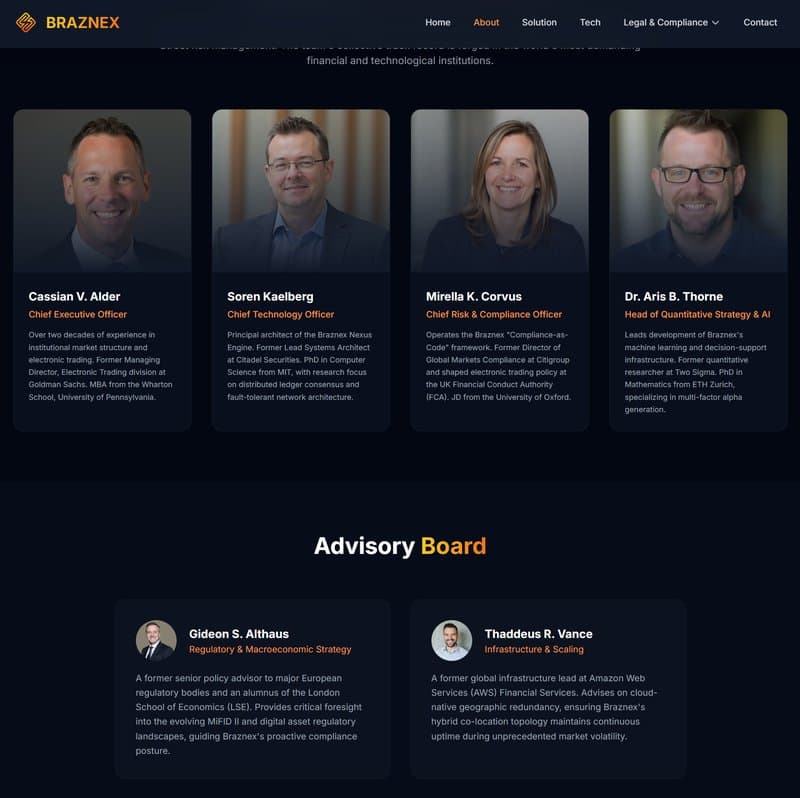
That is a serious problem.
If someone is truly the CEO of a “global multi-asset platform,” but almost the only public information about that person comes from the brand itself saying who he is, then the credibility is already weak. The more a platform relies on polished titles to support its image, the more it should be able to provide real public background to support those titles. If it cannot, it becomes difficult not to suspect that these executives are little more than carefully designed front-facing personas.
Even more troubling is the appearance of the name “Dr. Aris Thorne” in the BRAZNEX team. That name itself looks suspicious. On Reddit, users have already asked why “Dr. Aris Thorne” keeps appearing in so many places, and several people suggested that it is likely a template-style name repeatedly produced through AI training and generation. For a platform that claims to serve global markets, the fact that a core executive name carries such a strong AI-recycled feel is highly unusual. Taken together with BRAZNEX’s polished but thinly verifiable branding style, it raises serious questions about whether parts of its team presentation and promotional materials may have been generated in bulk with AI.
Put simply, real executives can withstand scrutiny. Fake teams are the ones that fear being checked.
The Website Is Full of Regulatory Labels, but There Is No Real License Behind Them
BRAZNEX fills its website with the names of regulators such as FCA, ASIC, MAS, SEC/FINRA, CySEC, ESMA, SCB, and CIMA. It repeatedly emphasizes “cross-jurisdictional compliance” and tries to create the impression that it is a globally licensed and mature platform.
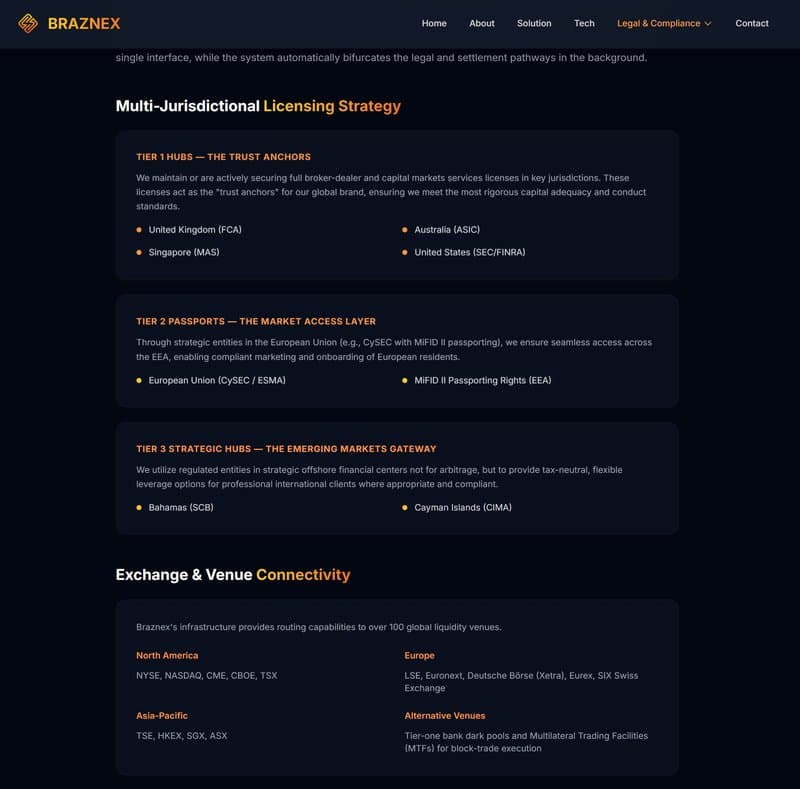
But real regulation does not work like that.
A truly regulated platform should make the basics clear: which legal entity operates the business, what license it holds, what the license number is, and whether that information can be verified in official databases. BRAZNEX does not provide regulatory entity details, license numbers, or official registration records that match the bold regulatory image it is trying to project.
Instead, it presents regulatory language as decoration. It uses the vocabulary of compliance without providing the evidence that actual compliance would require.
This is especially obvious when a platform throws out advanced-sounding terms while keeping the verifiable details vague. Real regulated firms are usually the least afraid of being checked. It is the ones relying on regulatory packaging that tend to flood users with impressive terminology while never producing proper official records.
It Looks More Like a Branding Operation Than a Business Earning Real Reputation
BRAZNEX’s online exposure path is also worth paying attention to.
It did not build credibility through long-term customer reviews, community feedback, or serious independent industry coverage. Instead, it followed a very typical route: self-published blog content, distributed brand articles, and then republication on third-party platforms. First came the Blogspot blog, then a branded article on TechFinancials, and then republication on MEXC as public content.
The biggest problem with that path is simple: it creates the illusion that “BRAZNEX is everywhere online,” but that is not the same thing as saying “many independent sources have verified BRAZNEX.”
In fact, MEXC’s repost itself makes clear that the article came from a public platform, is for reference only, and is not guaranteed for accuracy, completeness, or timeliness. That tells you a lot. A large part of BRAZNEX’s so-called outside presence is not the result of independent media investigation. It is promotional content being passed around and rehosted.
That is not the same as real reputation.
If a platform is genuinely credible, its most valuable asset is not paid-style brand content. It is when others choose to write about it independently. BRAZNEX gives the impression of a company that is in a hurry to manufacture visibility.
Even the App Does Not Match the Story, and That Is Not a Small Detail
There is another detail here that is especially bizarre.
An App Store app named ’Braznex‘ is listed under a developer called Hasan Can Yldrmolu, but the app description talks about battery records, price trends, usage analysis, and battery-related questions. In other words, it reads like a battery management tool, not a global multi-asset trading platform.
That is not the kind of thing that can be brushed aside as a minor mistake.
If a company is truly operating a financial trading infrastructure, then its website, brand narrative, media presence, and product entry points should all tell the same story. With BRAZNEX, the website talks about global markets, AI compliance, and institutional trading, while the app talks about battery management. If a brand cannot even keep its most basic information consistent, why should users trust it with funds, execution systems, or compliance claims?
A single issue can sometimes be dismissed. But when many different inconsistencies start to point in the same direction, they become warning signals.
BRAZNEX’s Harvesting Pattern Looks Very Similar to the “Investment Group Scam” Model Flagged by Regulators
This type of scam is not new.
In late 2025, the SEC and Investor.gov publicly warned that fraudsters were posing as “experts,” “professors,” “CEOs,” or successful investors in social media and private chat groups, pulling people into investment communities, creating the illusion that everyone else was making money, and then slowly pressuring victims to deposit funds. FINRA also warned that these scams were spreading rapidly through social media, text messages, and encrypted chat tools like WhatsApp and Telegram.
What makes BRAZNEX unsettling is not just that it is new, and not just that it overuses polished language. It is that its entire packaging logic closely resembles the same scam structure regulators have been warning about.
First, create a polished and professional-looking platform. Then spread blog posts, press-style articles, and reposted content to fill the internet with traces of legitimacy. Then use terms like “AI,” “compliance,” “institutional-grade,” and “global markets” to elevate credibility. Finally, move targets into private chats, social groups, or off-platform conversion channels.
The website does not openly say “we are using WhatsApp groups to harvest investors,” of course. But when a platform already lacks verifiable entities, shows suspicious team backgrounds, uses blurry regulatory claims, and puts marketing before transparency, it is already dangerous enough. At that point, ordinary investors should not be using their own money to find out what happens next.
BRAZNEX’s Operating Style Closely Resembles the Pattern Seen in Southeast Asian Scam Operations
Another major concern is that BRAZNEX’s overall operating style closely resembles the pattern commonly seen in scam operations linked to Southeast Asia in recent years.
These groups often follow the same playbook: they build a professional-looking trading platform, invent team identities, loudly advertise regulation, create the illusion of being “global” and “institutional,” and then use WhatsApp, Telegram, and similar chat groups to brainwash victims, fake profit stories, and eventually carry out the extraction phase.
That is exactly the flavor BRAZNEX gives off now.
When a platform has been online for less than a month, its team is barely traceable, its regulatory language is oversized, and its license information cannot be properly verified, then words like “professional,” “compliant,” and “global” stop sounding like proof of strength. They start looking like packaging. And the more urgently BRAZNEX tries to describe itself as something massive and sophisticated, the more it suggests that the image may not survive serious scrutiny.
Conclusion: BRAZNEX Looks Less Like a Mature Platform and More Like a Newly Built High-Risk Project Wrapped in Heavy Packaging
When all the clues are put together, BRAZNEX does not just have one or two problems. It has a chain of major concerns appearing all at once.
Its public presence is extremely new. Its promotional language far outweighs the amount of verifiable information available. Its team looks more like branding personas than real executives. Its regulatory claims are loud, but its actual license details are missing. Its outside visibility depends heavily on distributed articles and reposted content. Even its same-name app does not match the financial story it is telling.
So, is BRAZNEX a scam?
Based on the information that can currently be publicly checked, it already looks very much like a high-risk, heavily packaged, low-transparency platform. It does not look like a legitimate institution that clearly explains its identity, regulation, and business model. Instead, it looks much more like a newly built project rushing to present itself as “global” before it has earned the right to be seen that way.
For investors, the practical conclusion is simple: until BRAZNEX can provide verifiable legal entity details, license information, and real professional backgrounds for its team, it should not be trusted lightly. And no one should be sending money to it just because a group chat is filled with profit screenshots and polished claims.
