

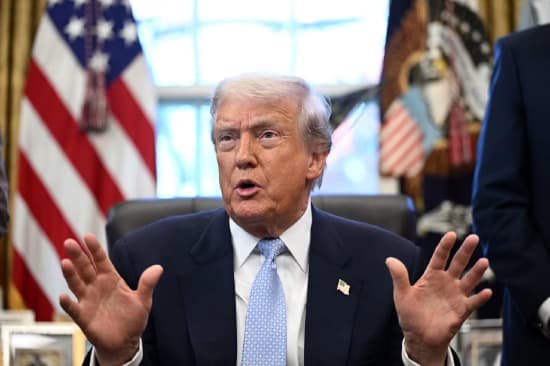
On Monday, European stock markets experienced a concentrated sell-off. After U.S. President Trump threatened to increase tariffs on multiple European countries, risk appetite quickly cooled, with high-end consumption and export-sensitive sectors seeing the most significant declines. As the U.S. was closed for Martin Luther King Jr. Day, there was no trading in U.S. stocks, but the S&P 500 and Nasdaq futures still fell more than 1.2% at one point, showing that the impact on sentiment was not completely isolated by the "holiday."
Broad Decline in European Stocks: Core Indexes Experience Significant Pullback
In terms of closing performance, the Euro Stoxx 50 index fell by about 1.77%, the French CAC 40 by about 1.78%, the German DAX by about 1.22%, the UK FTSE 100 by about 0.44%, and the Italian MIB by about 1.32%. Market participants attributed this volatility to "trade friction repricing," with particular concern that tariff threats might evolve from verbal pressure into an executable timeline.
Luxury Goods Hit Hard: Leading Companies Weaken, Downgrades Amplify Pressure
At the sector level, luxury stocks became the "focus" of the decline. Companies such as LVMH, Richemont, and Kering were among the biggest losers, with LVMH falling around 4%, and Richemont and Kering also seeing notable pullbacks. Analysts widely believe that luxury goods are extremely sensitive to external demand, exchange rates, and tariffs, making their short-term valuations more likely to be compressed by "policy uncertainty."
Notably, Morgan Stanley downgraded LVMH from "overweight" to "neutral/equal-weight," focusing on currency fluctuations and potential tariff impacts: given limited room for companies to completely offset cost increases through price hikes without deterring middle-income consumers. The bank also mentioned that some luxury groups have significant income exposure to the U.S. market (about 20% by some measures).
Tariff Timeline and Political Context: From "Threat" to "Executable Expectation"
Trump stated earlier that if Greenland-related negotiations do not progress, starting February 1, an additional 10% tariff would be imposed on imports from eight European countries, with a possible increase to 25% on June 1. This statement was interpreted by the market as a "dated negotiation chip," making it harder for companies to ignore the risk as mere "noise."
EU Evaluates Countermeasures; UK Prefers Dialogue First
On the policy front, several EU countries publicly criticized the tariff threats and discussed countermeasures, including imposing retaliatory tariffs on about €93 billion worth of U.S. imports (which had previously been suspended), and utilizing not yet "battle-tested" counter-coercion tools that could potentially cover broader areas such as service trade or investment.
The UK has signaled a more restrained response, emphasizing a preference for easing tensions through communication and stating that retaliatory tariffs have not yet been considered a preferred option. Some economists noted that even if there have been phased trade arrangements in the past, the White House might still use tariff threats as a long-term negotiation tool, which is why the market is repeatedly "shaken."
Forex and Capital Flow: Unusual Dollar Weakness, Diversification Expectations Rise
The reaction in the foreign exchange market also drew attention. Some strategists said it was more akin to "geopolitical risk" rather than just tariffs; unusually, under traditional safe-haven logic, the dollar usually strengthens, but this time it weakened, as the risk source is seen as U.S. policy uncertainty, possibly prompting more diversified allocations across regions and asset classes.
Meanwhile, the tariff dispute also adds tension to the upcoming World Economic Forum in Davos: global political and business leaders will engage in intensive exchanges, with trade and geopolitical issues expected to be one of the most unavoidable variables outside the venue.







