

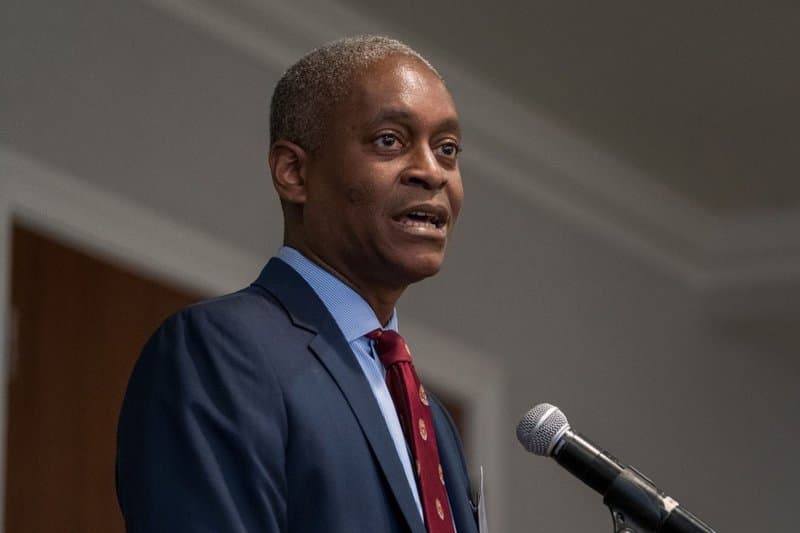
Bostic's Unexpected Departure Marks a “Sensitive Personnel Period” for the Fed
Raphael Bostic, President of the Federal Reserve Bank of Atlanta, announced he will retire at the end of his term in February 2026, a move that has sent ripples through Washington and Wall Street. As one of the few regional presidents in the Federal Reserve system with strong hawkish tendencies, his departure coincides with the Trump administration's intensified focus on Federal Reserve appointments. Analysts widely believe this decision is not just a matter of personal career plans but also a reflection of new challenges to the Fed's independence.
Bostic, who has served as the Atlanta Fed President since 2017, is the first Black economist in this role and openly gay. He has consistently advocated for prudent monetary policy, often highlighting the importance of guarding against inflation risks. This year, he ranked among the strongest advocates within the FOMC for “gradual rate cuts.”
A Departure Amidst Political and Ethical Complexities
On the surface, Bostic's retirement aligns with the end of his term, but the reasons are far more complex than the announcement suggests. Firstly, the Trump administration is pursuing a “soft restructuring” of the Fed. Though the White House cannot directly appoint regional Federal Reserve presidents, all candidates must be approved by the Federal Reserve Board, which is currently being restructured. Analysts suggest Bostic's exit opens a political appointment opportunity for Trump.
Secondly, Bostic faced an internal investigation in 2022 over investment disclosure issues. Although he was not found in violation, the investigation cast a shadow on his reputation. Many economists note that this "compliance flaw" could be magnified under current political pressure, making it a potential reason for his opting out of controversy.
In addition, Bostic has often publicly advocated for “reducing economic and social inequality” and pushed for inclusive growth topics to enter policy discussions. This stance clashes with the politically conservative environment, placing him at the center of media scrutiny. Multiple factors combined have led him to “gracefully exit before the storm.”
The Incoming President's Stance Will Determine 2026 Policy Direction
The Federal Reserve Bank of Atlanta will initiate a succession process in the coming months, with COO Cheryl Venable temporarily assuming duties. Under rotation rules, the Atlanta Fed holds FOMC voting rights in 2026, so the new President’s stance will directly affect that year's monetary policy direction.
Currently, the Federal Reserve's internal hawk-dove distribution is about 4:3:3, with Bostic belonging to a moderate hawkish faction. Should his successor favor a dovish stance, it would increase market expectations for further rate cuts in 2026. Conversely, if the successor maintains a hawkish stance, it indicates the Fed will persist in a “cautious relaxation” approach. Market observers point out that the appointment of Bostic's successor could be a key indicator of whether the Trump administration seeks to further influence Federal Reserve decisions.
Increased Strains on Independence as Relations Between Washington and the Fed Are Redefined
Bostic's departure heightens sensitivity surrounding the Fed’s independence. Trump has openly criticized the Federal Reserve for “acting too slowly” and hinted at replacing Chairman Powell. As regional president positions come up for renewal, the market is concerned that the White House may exploit procedural gaps to indirectly shape more compliant policy orientations.
An analysis by Barron's suggests the Fed may experience “multiple changes” before 2026, including adjustments in some Board members and regional presidents' positions. This not only affects the direction of monetary policy but also concerns institutional balance and international credibility.
Conclusion: The Symbolic Meaning of a “Quiet” Departure
Bostic's retirement statement is restrained but carries profound symbolic meaning—signaling not just an end to his personal career but possibly the beginning of a power structure adjustment within the Federal Reserve. In an environment where political influence is increasingly prominent, the boundaries of central bank independence are being redefined again.
In the coming months, the market will closely watch if the Trump administration takes this opportunity to consolidate control over the Federal Reserve, and Bostic's departure may just be the starting point of this institutional power play.






