

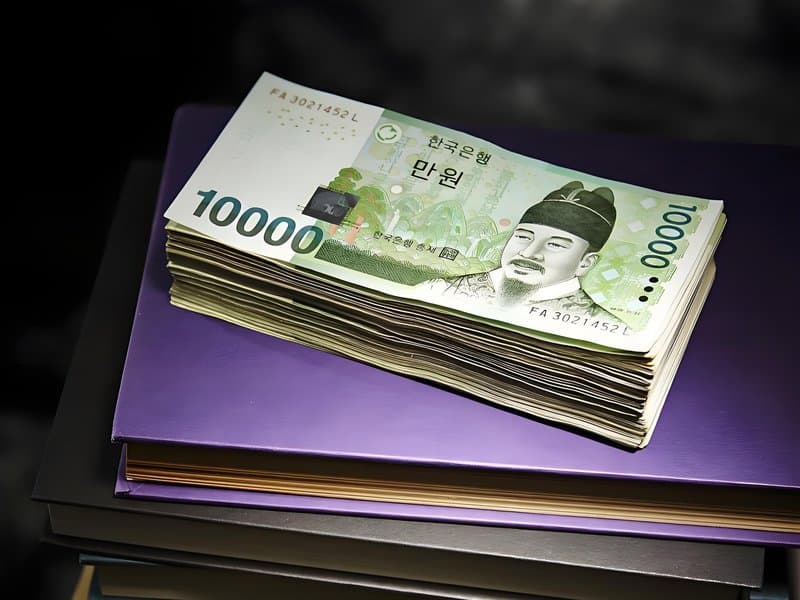
Korean Won Under Pressure as Authorities Signal Strong Policy Measures
As capital flows accelerate out of the South Korean market, the won has continued to weaken, causing concern from the government. South Korea's Deputy Prime Minister and Finance Minister Choo Kyung-ho stated at a regular press conference in Seoul on Wednesday that the authorities are closely monitoring the foreign exchange market and will not tolerate speculative one-way fluctuations. He emphasized that if fluctuations exceed a reasonable range, the government will "decisively intervene" and take necessary stabilization measures.
Although Choo Kyung-ho did not disclose specific policy tools, the market generally interprets this as the South Korean government's preparation for possible forex intervention. In recent weeks, the won has consistently depreciated, with a quarterly depreciation of nearly 4%, making it one of the weakest performing currencies in Asia, trailing only the yen.
Analysts point out that the won's weakness is mainly affected by three factors: domestic investors accelerating overseas asset purchases, continued foreign capital outflow from the Korean stock market, and constantly shifting expectations of U.S. rate cuts. As the dollar index remains strong, pressure on foreign exchange outflows from the Korean market increases further.
Complex External Environment Heightens Interference Expectations
The Finance Minister's statement coincides with the won approaching a seven-month low, heightening market focus on government intervention. Several investment banks note that South Korea historically tends to engage in "smoothing operations" when the won depreciates rapidly or there is a one-directional outflow of foreign funds, utilizing foreign exchange reserves or expanding policy declarations to guide market sentiment.
A forex strategist based in Seoul indicated, "South Korea's foreign exchange reserves can support short-term stabilization operations, but government attitude is more important than tools. Choo's speech is typical verbal intervention aimed at stabilizing market expectations first."
However, some believe that in the face of global risk preference fluctuations, relying solely on government intervention is unlikely to reverse the won's weakness. Uncertainty around U.S. monetary policy direction remains a key variable affecting Asian forex markets, and the Bank of Korea's own interest rate policy faces a dilemma: inflationary pressures have not entirely dissipated, but slowing economic growth limits room for rate hikes.
Policy Direction Hinges on Capital Flow and Fed Decisions
The South Korean government's concerns are not unfounded. Data shows that foreign investors have been offloading Korean stocks for several consecutive days, with some funds flowing to the U.S. market or other high-yield assets. Meanwhile, local institutional investors in Korea are also continuously increasing their dollar asset allocation, further reducing demand for the won.
The market generally believes that the won's short-term trend remains highly dependent on U.S. economic data and Federal Reserve policy signals. If the Fed indicates a clearer inclination towards rate cuts in the coming months, it could significantly alleviate forex pressure on South Korea; conversely, if U.S. inflation remains stable and delays the rate cut pace, the won may continue to face pressure.
Government Emphasizes Readiness as Market Awaits Next Moves
Although the South Korean Ministry of Finance has not revealed specific intervention details, the government reiterating that measures will be taken "immediately if necessary" is enough to prompt the market to reassess the won's short-term trend. Some traders believe that if the won continues to break key technical levels, forex authorities may initiate "silent intervention," involving direct counter transactions through state-owned banks to stabilize fluctuations.
Overall, the South Korean government is trying to strike a balance between stabilizing the foreign exchange market and maintaining economic growth. With the won remaining in a weak zone, upcoming policy statements and market reactions in the following weeks will determine whether there will be a turning point in the exchange rate.








