U.S. and Australia Deepen Strategic Cooperation with New Mineral Agreement
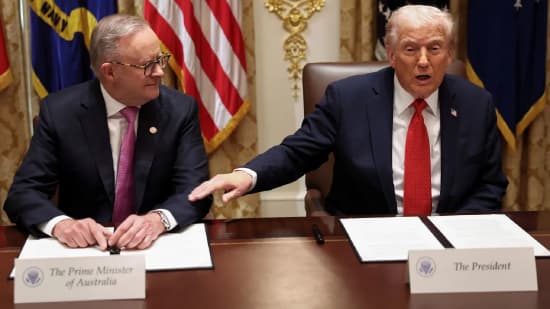
On Monday, local time, U.S. President Donald Trump and Australian Prime Minister Anthony Albanese jointly signed a key mineral cooperation agreement at the White House. This marks an upgrade in the strategic partnership between the two countries in the areas of energy security and high-tech supply chains. The agreement covers mineral and rare earth projects worth up to $8.5 billion, aiming to enhance the self-sufficiency of raw materials in the electric vehicle, battery, aerospace, and defense industries of both countries.
At the signing ceremony, Trump stated that U.S.-Australia cooperation is “a turning point for global critical mineral supply chain security” and emphasized that the agreement will provide long-term assurance for U.S. manufacturing and energy independence. Albanese remarked that this move aligns with Australia’s national interests and offers a “practical path” for global green transitions.
Investment Totals $8.5 Billion, Focus on Rare Earths and Battery Metals
According to plans released by Australia, the two sides will advance a portfolio of projects valued at approximately $8.5 billion over the coming years, covering rare earth mining, lithium processing, nickel and cobalt refining, and related infrastructure development.
Albanese disclosed that the first batch of projects will commence in the next six months, with both governments jointly funding $1 billion to support mineral projects that have completed feasibility studies. A fact sheet issued by the White House subsequently indicated that over $3 billion will be invested in the critical minerals sector within six months to “accelerate supply chain development.”
Analysts pointed out that this move by the U.S. and Australia is clearly a response to the risks of supply chain dependence on China. Traditionally, the global rare earth market has been highly concentrated in China, while the U.S. faces raw material bottlenecks in electric vehicle and defense equipment manufacturing. By deepening cooperation with Australia, Washington hopes to establish a "de-risked" mineral supply system.
Framework Agreement Strengthens Complementary Relations
The White House defined the agreement as a “strategic framework,” providing an institutional basis for future multilateral cooperation. Under the agreement, a joint steering committee will be established to regularly assess project progress, coordinate policy support, and explore mechanisms for private capital participation.
Australia’s Resources Minister Madeleine King stated that this framework will allow the two countries to form complementary strengths along the “resource-tech-market” chain. She highlighted that Australia possesses rich mineral deposits, while the U.S. has advanced processing and end-application capabilities. Together, the two nations will “reshape the global mineral landscape.”
Strategic Significance Amid Global Supply Chain Restructuring
Industry experts believe that this agreement extends beyond economic cooperation and into geopolitical strategy. With the accelerating global energy transition, critical minerals are now viewed as a focal point of a new wave of international competition.
Mark Campbell, a researcher at the Brookings Institution, noted that the deepening U.S.-Australia alliance represents a “collective Western response to critical material security.” He noted that while the $8.5 billion investment is relatively limited, its symbolic significance is substantial—it signifies that the U.S. is constructing a “trusted rare earth supply circle,” reducing external dependencies in the new energy and high-tech industries.
Moreover, this agreement could prompt follow-up actions from other allied countries. Canada, South Korea, and Japan are all in consultations with Australia about similar cooperation, potentially forming a multi-tier mineral cooperation network in the future.
Market Reaction and Outlook
Following the agreement's signing, Australian mining stocks collectively rose. Lithium giant Pilbara Minerals and rare earth producer Lynas saw their shares increase by more than 4% during trading, with the market expecting U.S. investment to accelerate the implementation of mineral projects.
Economists point out that the implementation of the U.S.-Australia cooperation will bring stable expectations to the new energy industry chain. As the scale of investment expands, the two countries may achieve partial self-sufficiency in key materials like lithium, rare earths, and cobalt by 2030.
However, some observers caution that mineral development involves long cycles, high costs, and complex environmental approvals. Achieving large-scale production will still require time and coordinated policies.