

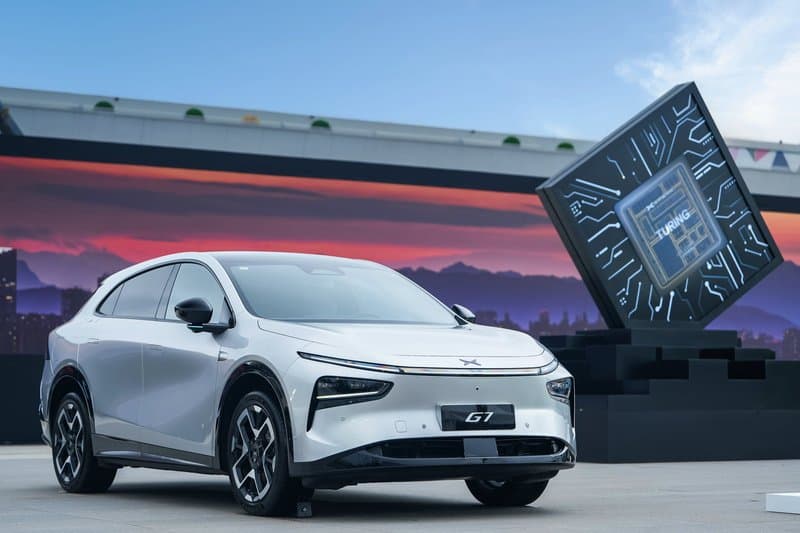
Xpeng's Revenue Expectations Disappoint, Triggering Market Sell-Off
After releasing guidance for its fourth-quarter revenue, Xpeng Motors saw its U.S. ADR shares drop over 10% overnight, marking the largest single-day decline in nearly three months, as expectations fell short of the broader market consensus. Investors are concerned that the company's short-term profitability might be under pressure due to increased competition in the electric vehicle market and a slowdown in domestic demand.
Citibank's latest research report notes that Xpeng's revenue outlook is below Wall Street's consensus expectations, reflecting the more daunting trade-offs the company faces between sales growth and margin recovery. Analyst Jeff Chung wrote in the report: “Management's guidance is relatively conservative, especially with its sales forecast for the first quarter of 2025, indicating a possible temporary slowdown in market demand.”
Citibank Slightly Lowers Target Price but Maintains 'Buy' Rating
Despite the short-term financial outlook pressure, Citibank still maintains a “buy” rating on Xpeng, only slightly lowering its target price. The bank revised Xpeng's U.S. stock target price from $29.4 to $28.4, a decrease of 3.4%; while its Hong Kong stock target price was adjusted from HK$114.8 to HK$110.6, a reduction of 3.7%.
Citibank pointed out that the adjustment mainly reflects the revision of the company's 2025 sales expectations to align with management's new operational guidance, but the overall long-term growth logic remains unchanged. The report emphasizes that Xpeng's foresight in technological R&D and new model layouts remains a crucial support for its valuation.
Diversification Strategy is Key, Robotics Business Could Become a Second Growth Curve
Facing a slowdown in the electric vehicle market growth, Xpeng Motors is accelerating the diversification of its business layout. Company management revealed at the latest briefing that it expects to launch seven new models around 2026, covering mid-to-high-end pure electric sedans, SUVs, and smart mobility product lines, further expanding its market share.
Meanwhile, Xpeng also plans to officially launch the Robotaxi (driverless taxi) project for trial operation in 2026, to test its autonomous driving system's stability and commercial feasibility in complex urban road environments. If this plan proceeds smoothly, it is hoped that Xpeng will be among the first companies to commercialize Robotaxi in the Chinese market.
More notably, Xpeng is investing in the long-term development potential of humanoid robots. The company expects to start mass production by the end of 2026, aiming to achieve global sales of over one million units by 2030. Management believes that humanoid robots will become the next-generation "super track" following smart electric vehicles, with a potential market size expected to exceed that of electric vehicles.
Investors Cautiously Optimistic, Market Focuses on Realizing New Business Potential
Despite short-term market sentiment being hit, some institutional investors believe that Xpeng's adjustment represents a temporary fluctuation rather than a deterioration in fundamentals. Several fund managers indicate that the company is transitioning from a single car manufacturer to an “intelligent mobility ecosystem provider,” offering room for long-term valuation expansion.
Morgan Stanley noted in a follow-up report: “Xpeng's challenge lies in balancing new technology investments with the pace of profitability recovery. If the Robotaxi and humanoid robot businesses can enter the commercial verification stage before 2026, it will significantly boost its confidence in the capital market.”
Technological Innovation Remains Core Competence
It is generally believed that Xpeng Motors is at a critical juncture for “adjustment and reshaping.” While short-term revenue pressure cannot be ignored, the company's profound accumulation in autonomous driving algorithms, intelligent interaction systems, and entire vehicle software architecture will still determine its competitive position in the smart electric vehicle sector.
In the conclusion of Citibank's analyst report, it is noted: “Short-term performance fluctuations should not overshadow Xpeng's technological potential. As new models are gradually launched and robotic projects advance, the company is expected to reach a growth inflection point in 2026.”
Overall, although Xpeng Motors is temporarily hindered by a sales off-season and declining market confidence, it is still regarded as a significant innovative force in China's electric vehicle industry with its AI-driven intelligent manufacturing and autonomous driving deployment.








