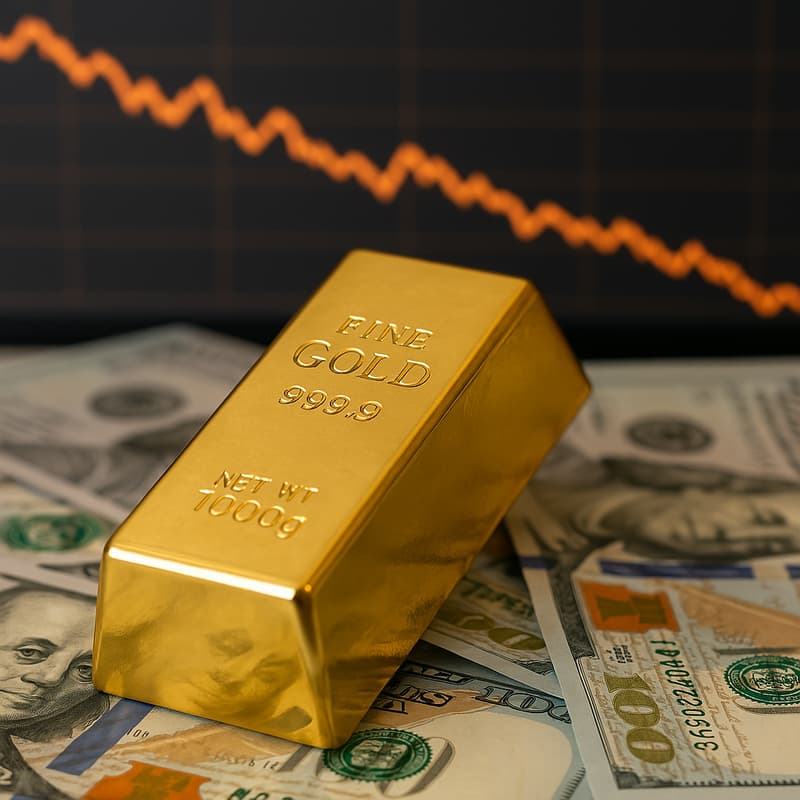
Gold Falls Below $3960 Mark, Investor Sentiment Turns Cautious
On Tuesday, international gold prices fell again, with spot gold briefly dropping below $3960 per ounce, hitting a two-week low. Following a 3.2% drop in the previous trading day, market sentiment remains under pressure, with diminishing safe-haven demand as the main driving force. Analysts point out that the temporary easing of trade tensions has weakened gold's appeal, causing investors to turn to risk assets, thereby intensifying short-term fluctuations.
Year-to-date, gold prices are still up about 50%, but have continued to decline after reaching an all-time high of $4380 per ounce last week, indicating limited market tolerance for high prices. The sharp volatility in gold has led some funds to exit the safe-haven market, with short-term traders inclined to take profits.
ETF Significantly Reduces Holdings, Institutional Strategies Shift to Wait-and-See
According to the latest statistics from data agencies, gold ETFs decreased holdings by approximately 449,000 ounces on Monday, valued at nearly $1.8 billion, marking the largest single-day divestment in six months. The outflow of funds indicates that institutional investors are reassessing the short-term risks and returns of gold.
Chris Weston, head of research at Pepperstone Group, stated that the gold market is experiencing a "momentum fade," with trading volume remaining high during the decline, demonstrating significant market divergence. "The current strategy is not to blindly bottom-fish but to wait for market stabilization before entering opportunistically," he said.
Meanwhile, at the LBMA annual meeting held in Kyoto, Japan, industry insiders generally believe that despite the intense short-term volatility, the long-term upward logic of gold remains solid. A survey of over a hundred participants showed that most expect gold prices to rise to around $5000 per ounce in the coming year.
Central Banks May Increase Holdings Amid Pullback, Gold's Allocation Value Reassessed
Industry experts suggest that the current gold price dip may provide a new buying opportunity for central banks. Reports from the LBMA meeting indicate that the Bank of Korea is studying the feasibility of increasing its gold reserves. If implemented, it would be the first gold purchase by South Korea in over a decade.
John Reade, a strategist at the World Gold Council, noted that although the pace of central bank gold purchases has slowed, this does not mark the end of the trend. He believes that the backdrop of long-term inflation expectations and a weakening dollar will continue to support central banks' demand for gold allocation.
Michael Widmer, an analyst at Bank of America, pointed out that from historical data, the current gold price increase is not extreme compared to the bull markets since 1970. A short-term correction to $3800 per ounce would be a reasonable adjustment range.
Fed Rate Cut Expectations Support Mid-Term Gold Price Trend
The market widely expects the Federal Reserve to cut interest rates by another 25 basis points at this week's meeting, lowering the rate range to 3.75%-4.00%. A rate-cut environment typically favors non-interest-bearing assets like gold. Meanwhile, the selection process for a new Fed chair to succeed Powell is in its final stages, keeping policy continuity a focal point for the market.
As of the close in New York, spot gold was quoted at $3954.94 per ounce, having hit a low of $3886 during the session; COMEX gold futures fell by 1.25% to $3969.40. Spot silver slightly rose by 0.5%, recording $47.09 per ounce, indicating that the precious metals market short-term remains divided.
Market Outlook
Analysts believe that the medium to long-term upward trend in gold is still unbroken. Global central banks' reserve structure adjustments, the cyclical decline of the dollar, and inflation resilience will continue to provide support. However, short-term market volatility may still intensify, and traders should pay attention to the key support level at $3900, as well as potential directional signals from Fed policy.