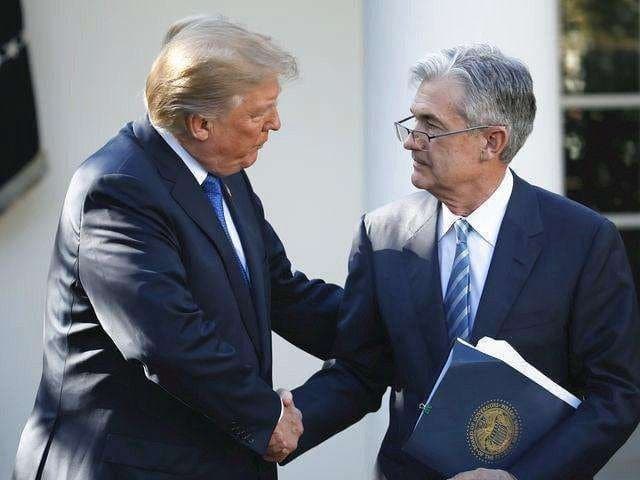
On May 8 local time, Trump once again lashed out at Federal Reserve Chairman Powell on his Truth Social platform, calling him a "fool" and a "total loser," accusing Powell of refusing to cut interest rates to boost the U.S. economic recovery. This public accusation has escalated into a rare direct confrontation in American financial history between a president and the central bank governor. Trump unapologetically stated, "Cutting interest rates would boost the economy like jet fuel, but Powell just won't do it." He also pointed to personal grievances between the two, bluntly stating, "Powell does not like me."
The core of this conflict lies in their fundamental disagreement on monetary policy. The Federal Reserve decided this week to keep the benchmark interest rate unchanged at the 4.25%-4.50% range, marking the seventh time since December last year. Powell emphasized at a press conference that although the new tariff policy of the Trump administration may drive up inflation and unemployment rates, current economic data does not show clear signals. Therefore, the Federal Reserve needs more time to observe the economic trend. Powell's cautious approach stands in sharp contrast to Trump's radical call for immediate rate cuts.
Trump retorted on social media, "Oil and energy prices are falling sharply, almost all costs are declining, and there is almost no inflation..." He further challenged the Federal Reserve's data-driven decision-making approach and insisted that the current economic situation does not require further rate hikes. It is noteworthy that Trump appointed Powell as the Federal Reserve chairman in 2018, and Powell was reappointed for a four-year term by Biden in 2022.
Amid this escalating monetary policy battle, Trump announced a "breakthrough trade agreement" with UK Prime Minister Starmer, which quickly caused market fluctuations. Traders swiftly adjusted their expectations, lowering the probability of a rate cut in July from 68% to 52%, and the expectation for the total rate cuts this year was reduced from more than three to around two. JP Morgan analysts noted that this agreement reduced economic uncertainty, thereby reducing the need for an emergency rate cut by the Federal Reserve.
This conflict is not Trump's first challenge to the Federal Reserve's independence. As early as 2018, he publicly criticized his appointee Powell over rate hikes. However, this confrontation is more intense, even in the last month, when Trump hinted at replacing Powell, causing a double whammy in the stock and bond markets and severely undermining investor confidence. Powell exhibited professional restraint typical of a central bank governor at a Wednesday press conference, refusing to directly respond to Trump's criticism, only stating, "I plan to complete my term." This statement conveyed Powell’s clear rejection of political interference in monetary policy, and he also remarked, "It's always been the opposite," suggesting communication issues between the Federal Reserve and the White House.
The fundamental reason for this conflict is not only the differences in monetary policy but also closely linked to Trump's new tariff policy. The tariff policy enforced by Trump could further drive up prices, while the Federal Reserve remains steadfast in fighting inflation. This contradiction not only influences the direction of monetary policy but also complicates the coordination of economic policy. The chief U.S. economist at Oxford Economics noted, "We are witnessing a rare policy triangle game—a trade policy that creates inflationary pressure, a president demanding rate cuts in response, and the Federal Reserve attempting to maintain policy coherence. This contradiction may persist until after the election."