

Over the past year, Yellen has visited China multiple times. After several unsuccessful attempts, the United States has probably come to realize that its collapse is inevitable. However, before the collapse, the Federal Reserve will do everything in its power to fight back like a trapped beast, creating unexpected rate hike expectations to disrupt the global economy, buying time for itself.
The current predicaments of the American economy
Currently, the Federal Reserve is faced with a new "impossible trinity" dilemma: alleviating the pressure of U.S. debt, curbing inflation, and avoiding a financial crisis.
Maintaining high interest rates in the U.S. increases the debt service pressure on U.S. Treasuries. According to the latest data released by the Federal Reserve, the total debt of the U.S. federal government has exceeded $34 trillion, with an annual interest rate exceeding 4%, nearing $1.4 trillion in annual interest payments alone.

The Congressional Budget Office once assessed in 2020 that federal government debt would not reach $34 trillion until 2029. However, this milestone was reached five years earlier, with the debt growing much faster than expected. Currently, the debt is increasing at a dramatic rate of $10 billion per day. If this debt were spread evenly across American citizens, it would amount to more than $100,000 per person. In contrast, in 2023, the total fiscal revenue of the United States was about $4.4 trillion. $1.4 trillion is equivalent to 30% of the U.S. government's annual revenue needed to pay interest alone, while last year, the total defense spending was only $858 billion.
To alleviate the pressure on banks and U.S. Treasuries, interest rates must be lowered. Clearly, the Federal Reserve has failed this time. With the continuous increase in U.S. interest rates over the past two years, global capital has driven up the prices of dollar-denominated assets such as U.S. stocks, real estate, Bitcoin, and gold to sky-high levels. Once the interest rate reduction cycle starts, the U.S. no-risk interest rate will instantly lose its attractiveness, funds will inevitably flee the inflated dollar-denominated assets, and scoop up cheap assets in other economies disrupted by U.S. interest rate hikes, ultimately leading to the recession or even collapse of the U.S. economy.
On the other hand, raising interest rates will put pressure on American banks. U.S. banks hold a large amount of U.S. Treasuries, and a high interest rate environment and expectations of further rate hikes will lead to a decline in Treasury values, resulting in massive losses in banks' Treasury investments. At the same time, high interest payments on deposits will add to the difficulties of banks already struggling, potentially pushing them to the brink of bankruptcy and triggering a systemic financial crisis. The collapse of Silicon Valley Bank last year proved this point. If it weren't for the Federal Reserve's quick cash infusion, the U.S. financial crisis might have erupted last year. However, maintaining high interest rates for a long time will unfortunately not just be a problem for small banks. When the time comes, the Federal Reserve might be helpless to save them.
Let's also look at the severe inflation in the United States.
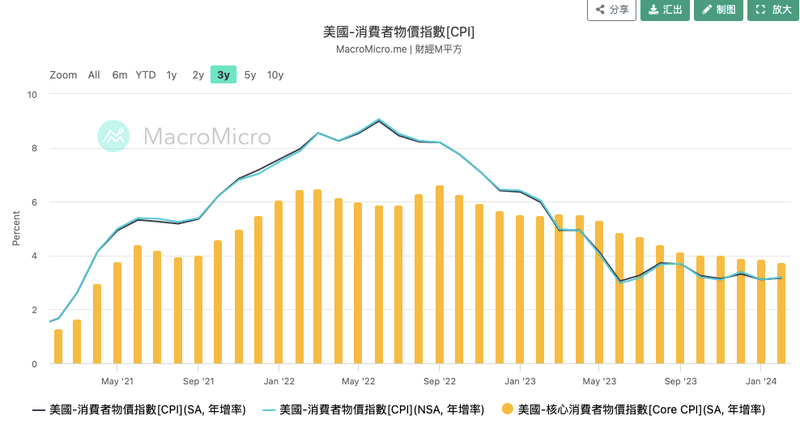
According to data from the U.S. Bureau of Labor Statistics, over the past three years, the inflation rate of core products in the United States has grown by more than 3.5% annually on average, totaling at least a 40% increase in core product prices over three years (calculated as 3.5% cubed), while total wage growth has not exceeded 15%. This means that the standard of living for the average American has fallen by at least 25% compared to the end of 2019, causing serious dissatisfaction among the American public.
To curb inflation, the Federal Reserve must lead the market to expect rate hikes to cool down. With current global commodity prices soaring, continuing to raise interest rates will lead back to increased pressure on U.S. Treasuries' debt service and a wave of bank failures. Therefore, the article begins by saying that the recent surge in commodity prices is the last straw breaking the American economy.
Whether the Federal Reserve decides to cut rates, raise rates, or stand pat, it must choose the lesser of two evils among inflation, banking, and U.S. Treasuries. Continuing to raise rates can not only curb inflation but also push other economies to make up for U.S. losses, at the cost of letting the banking sector face a crisis and triggering a financial crisis. However, this consequence might be the lightest. After all, managing inflation is one of the three main goals of the Federal Reserve, not financial crisis. At this point, no one can save the U.S. economy. As chair of the Federal Reserve, Yellen must know at least what to do to avoid negligence. Therefore, the day after the old lady returned, the exchange rate began to make subtle moves, which also proves that the United States has accepted the reality of the "impossible trinity." But they won't allow themselves to collapse first, thus giving others a chance to benefit. Therefore, they will inevitably continue to drag the rest of the world down, while harvesting another round, to avoid being the first to collapse and continue to fight for time. For this purpose, global geopolitical crises and economic and financial crises will all serve this goal. The more chaotic it is, the more countries fall into crisis, the more it benefits a certain hegemonic country seeking its own interests.
It is for this reason that the "classic lie" once revered by Western economic researchers, that the trends of gold prices and dollar prices are inversely related, has been debunked by reality. With the start of the U.S. interest rate hike cycle, gold prices have also begun a wild upward surge.
The surge in gold prices stems from its safe-haven attribute
The trend of rising gold prices is mainly due to the global need for safe-haven assets.
Whether it's the intensification of global geo-political conflicts, central banks worldwide continuously purchasing gold bullion reserves, or ordinary people proactively storing gold assets to hedge against possible inflation in troubled times, all these factors are pushing gold prices higher.
Data shows that as of the end of January 2024, China's gold reserves were 72.19 million ounces, an increase of 320,000 ounces from the end of December 2023. This marks the 15th consecutive month of gold reserve accretion. At the current price of $2250 per ounce, the total is about $160 billion, accounting for about 5% of the $3.2 trillion in foreign exchange reserves.
Regardless of whether the Federal Reserve cuts or raises interest rates next, it will not affect gold's safe-haven attribute.
This is for two reasons. First, if the Federal Reserve raises interest rates beyond market expectations, it is highly likely to adopt a high interest rate and loose monetary policy model. While raising interest rates, the Federal Reserve would pause or even expand its balance sheet, because raising interest rates quickly would exacerbate the bank failure wave. To prevent bank failures from impacting the economy, the Federal Reserve would still use emergency rescue tools to support the banking sector, minimizing the damage of systemic financial crises caused by the banking crisis to the U.S. real economy. This combination is essentially a highly distorted monetary policy, as emergency rescue tools are essentially starting the U.S. money printing machine. Excessive currency issuance would further weaken the credibility of the dollar, thereby pushing greater risks into the future until the U.S. economy completely collapses. This process would further highlight gold's safe-haven property.
Second, if the Federal Reserve does not adopt the above distorted combo but opts for a rate cut, funds will flee the U.S. homeland, causing a crisis in dollar assets. Gold remains the optimal choice for safe-haven capital.
In summary, the world economy has become extremely distorted and torn, with the rapid accumulation of dollar asset bubbles over the past few years beyond the solution of any conventional measures. The various measures introduced by the Federal Reserve are merely postponing risks until everything collapses. The twilight of the dollar not only tears apart the U.S. economy but also re-illuminates the glorious light of gold. As long as the old economic order is still struggling to survive and a new economic order has not yet been established, the global economy will still struggle under the dominance of the dollar order, and chaos will continue, making gold undeniably the best safe-haven asset.






