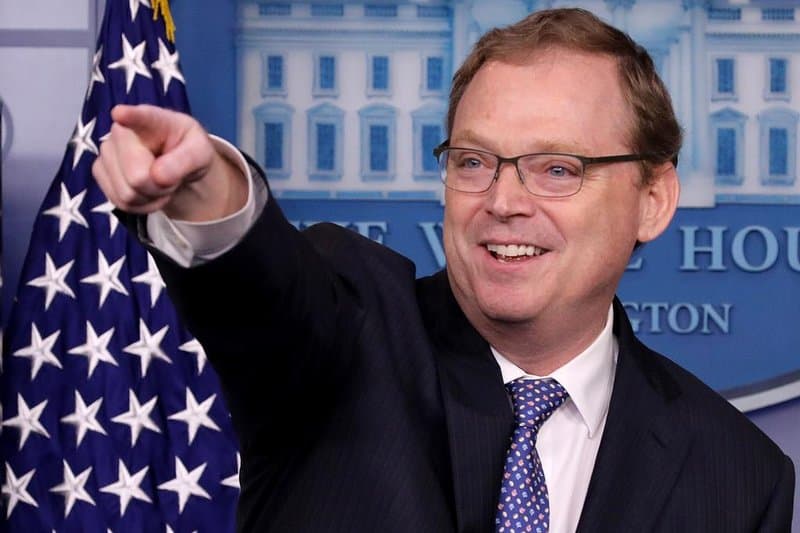
Hassett Claims If He Leads the Federal Reserve, He Will Advocate for More Significant Rate Cuts
Kevin Hassett, Director of the White House National Economic Council, sparked market discussions with his recent speech at the Washington Economic Club. He revealed that he had informed President Trump of his willingness to serve as the next Federal Reserve Chairman and clearly expressed support for a 50-basis point interest rate cut at the December policy meeting.
As one of Trump's most trusted economic advisors, Hassett's remarks were seen as a "signal" of discontent with current monetary policy and as a potential prelude to his nomination. Market analysts believe this statement might reignite external attention on the Federal Reserve's independence.
Inclination Toward Greater Easing, Criticizing Powell's "Overly Conservative Action"
Hassett pointed out in his speech that the current Federal Reserve Chairman Powell failed to take more proactive easing measures in the face of government shutdowns and falling inflation, which was "surprising." He said, "Given the current economic indicators, a 25-basis point rate cut by the Federal Reserve is almost certain, but I think this is far from sufficient."
He emphasized that the U.S. economy faces dual pressures from fiscal and administrative levels, with each week of government shutdown causing an estimated GDP loss of about $15 billion. Meanwhile, September inflation data fell below market expectations, providing policy space for more significant rate cuts.
"The President believes there is significant room for rates to decline, and I completely agree," Hassett stated. "A 50-basis point cut is not only a reasonable choice but also a timely action."
Trump's "Reshaping of the Fed" Plan Advances, Hassett as a Leading Candidate
Since this summer, Trump has repeatedly hinted at replacing the Federal Reserve Chairman when Powell's term expires in 2026. Hassett, as former Chairman of the Council of Economic Advisers (CEA) and current National Economic Council chief, is seen as one of the candidates "most aligned with the President's vision."
Multiple informed sources disclosed that Hassett has engaged in preliminary discussions with Trump about taking over, though the timing of the nomination remains uncertain. Since Powell's term officially ends in May next year, an early announcement may trigger political controversy. Hassett himself remains cautious, stating that "an early nomination would lead the confirmation process into a prolonged political confrontation."
Analysts believe that if Hassett becomes the Chairman, the Federal Reserve may enter a period of "more execution-oriented but also more politically tinged" policies. JPMorgan economists noted, "He tends to view monetary policy as a tool to serve growth objectives, rather than a single price stability framework."
Promising to Restructure the Research Department, Emphasizing "Technology-Oriented" Decision-Making
In his speech, Hassett particularly emphasized the urgent need to reform the Federal Reserve's research system, citing the current forecasting methods' lack of sensitivity to complex economic environments. "If I lead the Federal Reserve, a priority would be to rebuild a top-tier economic modeling team and introduce nonlinear time series analysis to enhance policy foresight."
He added that he had worked at the Federal Reserve for five years and is familiar with the institution's operations and key department heads. "I understand the limitations of internal research and know which mechanisms need updating." He believes the Federal Reserve needs to restore technically neutral and data-driven decision-making standards, rather than being swayed by partisan positions.
Despite Different Philosophies, Still Holds Respect for Powell
Although there are policy differences, Hassett still expressed "high respect" for Powell. He said, "I have worked with Mr. Powell for many years, and we share no conflict in core goals, only differing views on the approach."
This statement is seen as Hassett maintaining political flexibility while paving the way for a potential succession. Market observers believe Hassett's tone is noticeably more moderate than Trump's, indicating his aim to present himself as a "rational reformer."
Federal Reserve's Future May See Policy Shifts
Hassett's remarks not only suggest he is formally entering the succession discussion but may also indicate internal policy divergences within the Federal Reserve. With the dual impact of government shutdowns and slowing inflation intensifying, monetary policy in the coming months may usher in a more accommodative pivot.
If Trump ultimately nominates and obtains Senate approval, Hassett's appointment will mark the beginning of a new era of concurrent politicization and technologization of the Federal Reserve. As he stated, "Monetary policy must return to data and growth, not fear and inertia."