

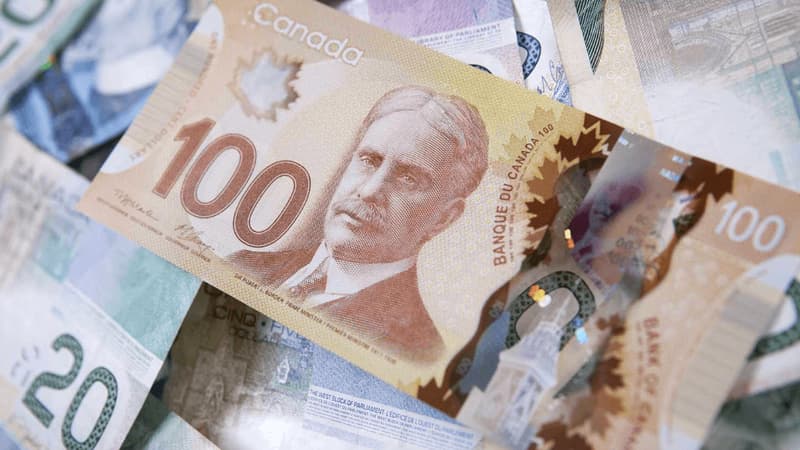
Dollar Rebound Helps Exchange Rate Stabilize, Government Shutdown Risk Cools, Boosting Market Confidence
During the Asian trading session on Tuesday, the USD/CAD regained support after two consecutive days of decline, with the exchange rate rising to around 1.4030. The dollar's rebound was mainly attributed to the significant easing of the U.S. government shutdown risk, which positively restored market sentiment.
U.S. President Donald Trump publicly expressed support on Monday for the bipartisan temporary funding agreement in Congress. Subsequently, the Senate passed the initial procedural vote with 60 votes to 40, moving the budget bill to the final review stage. Majority Leader John Thune stated that once Congress passes it, Trump will sign the bill to restore government operations.
This progress alleviated market concerns about a prolonged shutdown, reduced safe-haven demand, and pushed the dollar index above the 104 mark. At the same time, U.S. Treasury yields stabilized, providing additional support for the dollar. Analysts pointed out that if the government is officially reopened, expectations for the resumption of short-term economic activity in the U.S. will further strengthen the dollar’s stability.
Federal Reserve Sends Dovish Signal, Rate Cut Expectations Dominate Dollar Trend
Although the dollar gained short-term policy boost, the dovish tone from the Federal Reserve continues to dominate the medium-term trend. Recently, several Federal Reserve officials suggested in speeches that monetary policy might be further loosened to ensure growth during the inflation cooling phase.
Federal Reserve Board Member Stephen Miran stated in an interview with CNBC that U.S. inflation is continuously slowing, supporting the continuation of the rate-cut path. He noted that the possibility of a 50 basis point or at least a 25 basis point rate cut at the December meeting is "under discussion."
Meanwhile, St. Louis Federal Reserve President Alberto Musalem also emphasized that although current inflation remains close to 3%, above the policy target, the monetary environment is no longer highly tight, allowing further easing space in the future.
Market expectations indicate that the probability of a rate cut in December has risen to 64%, providing a dual impact on the dollar—short-term supported by safe-haven sentiment, but facing potential pressure from easing policy in the medium term.
Canadian Employment Performance Shines, Strengthening Short-term CAD Support
Contrasting with the U.S. macro policy uncertainty, Canada's latest employment data is unexpectedly strong, serving as a key factor limiting the upward movement of USD/CAD. Canada's unemployment rate fell to 6.9% in October, better than the previous 7.1%; employment increased by 66,600, marking the third consecutive month of growth, with the labor participation rate rising to 65.3%.
This data strengthens the market's expectations that the Bank of Canada (BoC) will keep interest rates unchanged. Analysts believe that the robust performance of the employment market gives the BoC more room to delay rate cuts, thereby providing short-term support for the CAD.
The National Bank of Canada pointed out that "although the Canadian economy faces challenges from external demand slowing, the resilience in employment growth indicates that domestic demand remains strong, which might offset part of the pressure from the dollar rebound in the short term."
Technical Analysis Shows Bulls Remain Active, Exchange Rate Oscillating in Short-term Range
From a technical perspective, the USD/CAD has stabilized above the 1.4000 level. The daily structure shows that the exchange rate has been running above the 9-day Exponential Moving Average (EMA) for three consecutive days, indicating a resurgence in buying sentiment. The Relative Strength Index (RSI) hovering above 50 suggests that bullish momentum remains ongoing.
Resistance is located in the 1.4070 to 1.4150 range, and a breakthrough above that area could open up further upward space; support is focused on 1.3950, and a break below it might trigger a pullback to 1.3900. Overall, the short-term structure remains in a state of oscillating consolidation, with the 1.3950—1.4150 range expected to be the main trading band in the near term.
Temporary Dollar Dominance, Potential CAD Counterattack Space
Overall, the easing of the U.S. government shutdown crisis and the rebound of the dollar index provide support for the short-term stabilization of USD/CAD. However, as the market refocuses on the Federal Reserve's December meeting, rate cut expectations may become a potential pressure point on the dollar's trend.
Meanwhile, the resilience of the Canadian employment market provides defensive support for the CAD. If subsequent data remains strong, investors may reevaluate the value of CAD assets, leading to high-level oscillations or even short-term pullbacks in USD/CAD.
Foreign exchange strategists generally believe that in the coming days, the market will fluctuate around Federal Reserve speeches and Canadian macro data, with the USD/CAD expected to maintain a range-bound pattern in the short term, with both bulls and bears engaging near the 1.40 level possibly lasting until the weekend.








