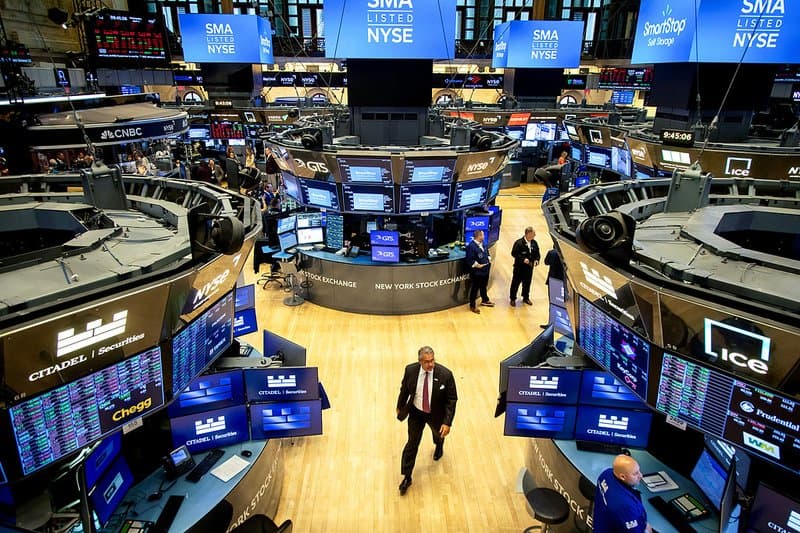
Mixed Performance of the Three Major U.S. Stock Indices
Last Friday, the U.S. stock market exhibited a noticeable divergence. The Nasdaq index, driven by the tech sector, rose slightly by 0.13%, closing at 22,900.59 points. The S&P 500 index dipped marginally by 0.05%, ending at 6,734.11 points. The Dow Jones Industrial Average performed the weakest due to declines in UnitedHealth Group and Visa shares, closing down 0.65% at 47,147.48 points.
At one point during the session, all three indices fell by over 1% due to deteriorating market sentiment. Traders noted that while some buying towards the end supported the Nasdaq, overall market confidence remained lacking.
Cooling Rate Cut Expectations Lead to Cautious Fund Movements
The main market fluctuations stem from changes in Federal Reserve policy expectations. Recent inflation indicators suggest continuing price pressures, leading to a sharp decrease in the anticipated December rate cut probability. According to the CME FedWatch tool, the probability has dropped from 67% last week to below 50%.
Kansas City Fed President Schmid's remarks further dented market confidence. He reiterated that the Fed "cannot afford to be complacent" in addressing inflation issues and hinted that policymakers favor maintaining a tight stance. This commentary made investors worry that the Fed might delay its rate reduction schedule or maintain high rates for a longer period.
Analysts believe that the cooling of rate cut expectations will continue to limit the stock market's rebound potential, especially for high-valuation tech growth stocks, which might become a major source of short-term market volatility.
Nvidia Earnings in the Spotlight
The market is currently focusing on the upcoming Nvidia quarterly earnings report. The company is seen as a barometer of the AI boom, and its performance results not only impact the semiconductor sector but are also considered a litmus test for the sustainable growth potential of the entire AI industry.
Analysts generally believe that if Nvidia's revenue and profits for this quarter exceed expectations, it will boost market confidence in AI-related companies and potentially lead to a new rally in tech stocks. Conversely, if the earnings are below market expectations, it might trigger short-term profit-taking and increase index volatility.
The Morgan Stanley analysis team noted, "AI concepts remain the market's emotional engine. Even if Nvidia's growth slowdown is only short-term, investors might quickly return to the market after a correction."
Lack of Economic Data Causes Policy Assessment Challenges
In addition to policy and corporate earnings factors, some investors are also concerned that a U.S. government shutdown might lead to the permanent loss of key economic data, affecting the market's judgment of the macroeconomic situation. Particularly, with the October non-farm payrolls and CPI data yet to be released, the market lacks clear signals of economic direction.
Goldman Sachs analysts pointed out, "If the Fed cannot obtain complete data before making decisions, it will be more inclined to maintain the current interest rate levels. This 'blind spot' increases market uncertainty and makes it difficult for investors to form a consistent expectation."
Summary
Overall, in an environment where high valuations and policy uncertainties coexist, short-term volatility in U.S. stocks is inevitable. The tech sector remains the core force supporting the market, but fund movements have shown caution. As Nvidia's earnings report is released and the Federal Reserve meeting approaches, investors' focus will shift from emotional trading to fundamental validation, and U.S. stocks may enter a new "data-driven" phase.