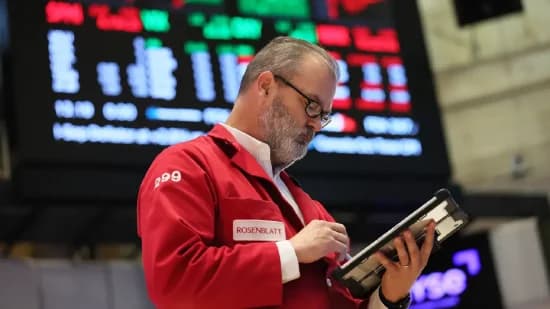
U.S. Stocks Plunge, Dow Drops Over 550 Points
On Monday, U.S. stocks significantly retreated under the collective weakening of tech stocks and AI concept stocks. The Dow Jones Industrial Average closed down 1.18%, dropping 557.24 points to 46,590.24; the S&P 500 fell 0.92%, closing at 6,672.41; and the Nasdaq Composite dropped 0.84%, closing at 22,708.07.
Analysts pointed out that this decline stems from investors' reevaluation of high valuations in the AI sector and a sharp cooling of expectations for Federal Reserve rate cuts. Market risk aversion heightened, with clear sector rotation; although cyclical and financial stocks provided some support, they were unable to offset the widespread selling pressure on tech stocks.
NVIDIA Under Pressure Ahead of Earnings, Investors Focus on AI Bubble
AI giant NVIDIA became the market focus, with its stock falling 1.9%, continuing its weak performance over recent weeks. The company is set to announce its third-quarter earnings after the market closes on Wednesday, which many investors believe will be a "litmus test" for confidence in the AI industry.
NVIDIA's stock has skyrocketed nearly tenfold since the AI wave surged at the end of 2022, reaching over $5 trillion in market cap this year. However, growing concerns over overinvestment in AI and increasing uncertainty about corporate returns have recently led to frequent sell-offs of its stock.
Baird Investment Strategist Ross Mayfield noted, "The market is no longer simply chasing growth stories; investors want to see tangible returns from AI spending. If NVIDIA's guidance is cautious, it could trigger further pullbacks."
Cooling Expectations for Rate Cuts, Market Reevaluates Policy Outlook
The uncertainty of the Federal Reserve's monetary policy has also been a significant drag on the market.
According to CME FedWatch data, the probability that the Federal Reserve will cut rates by 25 basis points at the December meeting has dropped to about 40%, down sharply from over 90% a month ago. Recent statements by multiple officials, including Kansas City Fed President Esther George and Dallas Fed President Lorie Logan, have expressed caution toward easing policy in the short term, prompting investors to reassess the likelihood of a rate cut this year.
The Federal Reserve will release the minutes of its October policy meeting this coming Wednesday, with the market looking for signs of internal opinion divisions. Meanwhile, several voting members will speak in the coming days, and investors will closely follow their latest views on the economy and inflation trends.
Economic Data and Corporate Earnings Drive Market Sentiment
Beyond AI concept stocks, the retail sector is also under the spotlight. Walmart and Home Depot are scheduled to release their earnings this week, and investors hope to use these to assess the resilience of U.S. consumer spending. Ross Mayfield commented, "Consumer sector data will be one of the most crucial signals ahead of the holiday season, especially with the current lack of labor market data."
Additionally, the U.S. September non-farm payroll data will be released this week, marking the first complete economic report since the government shutdown. Analysts say the result of the employment data could play a decisive role in the Federal Reserve's December policy path.
Buffett Backs Alphabet, Stock Rises Against the Trend
Amid the general market downturn, Alphabet was among the few bright spots. Boosted by news of Berkshire Hathaway's stake, Alphabet's stock closed up 3.1%. Although Buffett himself may not have made the decision personally, the market interpreted this move as a signal of long-term confidence in AI core assets. Analysts noted that Berkshire's increased holding has buoyed Google's stock price and, to some extent, alleviated the overall pessimism toward tech stocks.
Volatility Expected to Persist, Market Awaits Key Signals
Investors widely believe that U.S. stock market volatility will increase further in the coming weeks. The ability of AI valuations to withstand earnings scrutiny, the clarity of the Federal Reserve's policy direction, and the stability of consumer spending will be crucial variables in determining market direction.
Analysis suggests that the current U.S. stock market is in an "emotional rebalancing phase," with investors shifting from "optimistic growth expectations" to a "revenue verification period." If NVIDIA's earnings report and non-farm payroll data fall short of expectations, U.S. stocks may face the year's largest correction pressure.