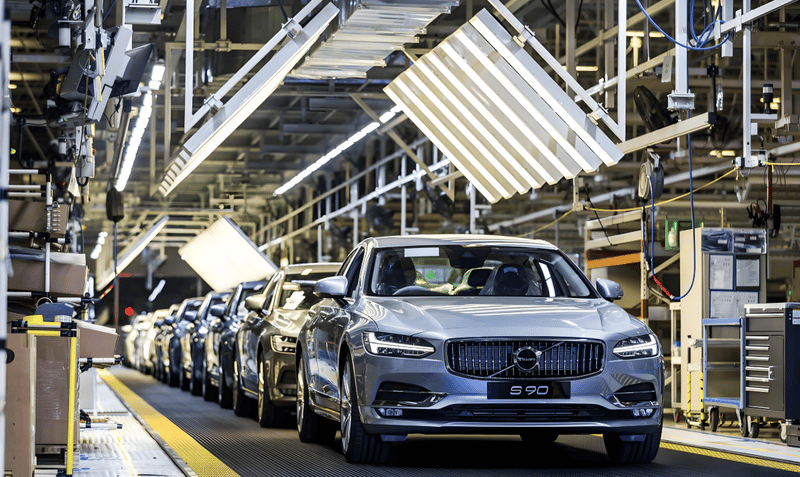
Volvo has announced plans to lay off up to 800 employees at its three major U.S. plants within the coming months due to the uncertain impact of President Trump's tariff policies on car demand.
With the Trump administration's tariffs taking effect, the U.S. auto industry faces unprecedented challenges. Rising costs and supply chain disruptions have put significant pressure on major automakers, and Volvo is no exception. Recent reports indicate that Volvo has informed its employees of layoffs at the Mack Trucks plant in Macungie, Pennsylvania, as well as at two Volvo plants in Dublin, Virginia, and Hagerstown, Maryland.
The total number of affected employees is expected to be between 550 and 800. Volvo stated that it must adjust production to respond to reduced market demand for its vehicles. The company noted that the uncertainty caused by tariff policies makes sales declines unavoidable in the short term.
A Volvo spokesperson emphasized that the current layoffs are not a long-term operational decision but a response to changes in the external economic environment. Volvo also stated that the company currently has nearly 20,000 employees in North America, indicating that the layoffs will impact various aspects of its production, supply chain, and sales operations.
Impact of Trump's Tariff Policies on the Automotive Industry
Trump's tariff policies have greatly impacted the global automotive industry. The tariff increases have not only led to rising production costs but also created instability in supply chains, posing significant challenges for automakers in production planning and inventory management. Companies like Volvo have had to resort to layoffs as they adjust production models to meet changing demand.
For Volvo, the North American market has always been a crucial sales region. Although Volvo has implemented some strategies to adapt to market changes, the uncertainty brought about by tariffs has necessitated adjustments. This layoff decision could significantly affect Volvo's operations in the U.S., and the scale of layoffs may further increase as the market evolves.
Looking Ahead
As the Trump administration continues to implement tariff policies globally, other automakers might face similar challenges. Volvo's current layoff plan represents only the tip of the iceberg, and more companies are expected to adjust based on market demand over the coming months. As tensions between the U.S. and its trade partners intensify, the automotive industry's response to this series of policy changes becomes a focal point of attention.
Volvo also stated that despite current difficulties, the company remains optimistic about future market prospects and is committed to enhancing production efficiency and optimizing supply chains to navigate the uncertain economic environment.