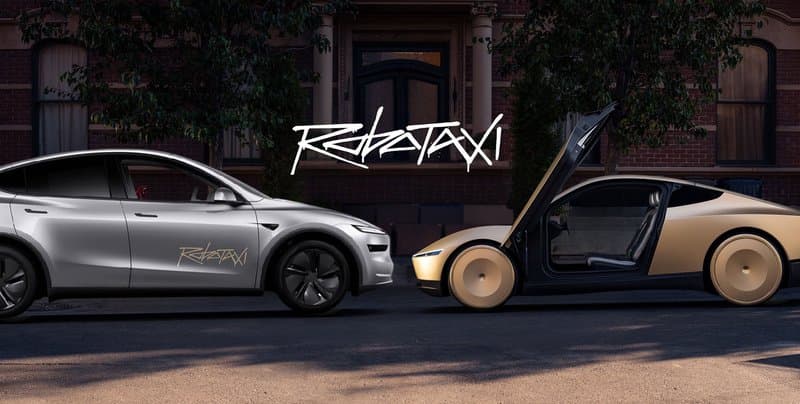
Tesla's dual progress in the capital market and technological pathways is reshaping investors' expectations for the commercialization prospects of autonomous driving. As the stock price reaches new historical highs, this electric vehicle giant once again occupies the core position of global technology and capital attention.
Stock Price and Market Value Reach New Highs, Confidence in Capital Market Continues to Accumulate
On Tuesday, U.S. Eastern Time, Tesla's stock price closed up 3.1% at $489.88, setting a record closing high. Accompanying the stock price rise, its market value ranking further climbed, successfully entering the top seven listed companies by market value in the U.S. Since the beginning of the year, Tesla's stock price has risen by nearly 30%, significantly outperforming most large tech stocks in the same period.
The market generally believes that the core factors driving the stock price strong are no longer limited to traditional vehicle delivery data, but more from the long-term imaginative space of autonomous driving, artificial intelligence, and future mobility models. Robotaxi is considered one of the most disruptive business directions in this regard.
Wall Street Reshapes Expectations as Robotaxi Enters the Stage of Large-Scale Simulation
In the latest research report, Morgan Stanley has given a more aggressive long-term judgment on Tesla's Robotaxi business. The institution believes that Tesla is gradually moving from the technical verification stage to the early stage of commercial deployment, and the fleet size is expected to expand significantly in the coming years.
In the short term, Robotaxi will still operate on a limited scale in specific areas, but the significance of this stage lies more in accumulating real road data and operational experience. Morgan Stanley points out that compared to the current magnitude, what truly deserves attention is the volume potential within a ten-year cycle, predicting that Tesla may eventually build a network of autonomous vehicle fleets with millions of vehicles in multiple cities across the U.S.
Cybercab Mass Production Nearing, Special Model Restructures Cost Structure
One of the key variables supporting the long-term expansion of Robotaxi is the Cybercab model designed specifically for autonomous driving scenarios. This model no longer follows traditional car design logic, omitting the steering wheel and pedals, retaining only a two-seat layout and fundamentally restructuring around driverless use.
Tesla plans to start mass production of the Cybercab in April 2026 and introduce its latest "unboxed" manufacturing process. This process, through modular disassembly of the production flow, is expected to significantly shorten manufacturing cycles and reduce unit costs. The market generally believes that the combination of a special model and the new manufacturing method is a necessary prerequisite for Robotaxi to achieve scalable operations.
Three Key Observations Determine the Pace of Commercialization
Analysts point out that whether Robotaxi can truly be implemented still depends on the continuous advancement of several practical conditions. First is the provision of services to the public without safety drivers, then whether safety indicators can continue to be optimized as operational scale expands, and finally the coordination and adaptation of regulatory environments during cross-state and cross-city promotion.
As test mileage accumulates, Tesla's autonomous driving system will face more complex real-world scenarios. The capital market is closely monitoring the progress of these key points to evaluate the real speed of Robotaxi's transition from concept to mature commercial model.
Autonomous Driving Becomes a Core Variable in Long-term Valuation
From the current trend, Tesla's valuation logic is undergoing profound changes. Vehicle manufacturing is no longer the sole pillar; autonomous driving, software services, and the future travel ecosystem are becoming important components that support its long-term imaginative space.
If Robotaxi can advance as expected, it may not only reshape urban travel structures but also open up a whole new revenue model for Tesla. It is against this backdrop that the market has given unprecedented attention and pricing space for its development over the next decade.