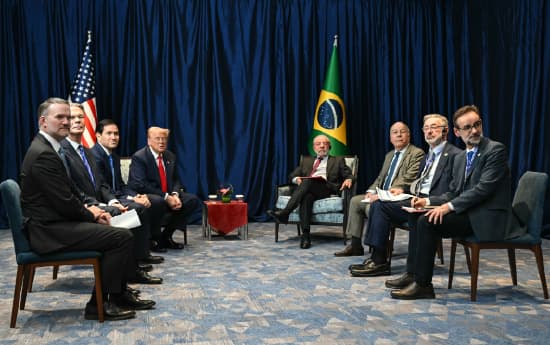
Trump and Lula Meet: Trade Talks Reopen
After months of diplomatic tension, relations between the United States and Brazil are taking a positive turn.
U.S. President Donald Trump and Brazilian President Luiz Inácio Lula da Silva held a bilateral meeting during a regional summit in Malaysia, jointly announcing the resumption of trade negotiations between the two nations.
Following the meeting, Trump stated that he and Lula had a “frank and constructive dialogue” and expressed optimism about reaching a significant trade agreement in the near term.
According to a White House statement, U.S. Trade Representative Jamieson Greer and Secretary of State Marco Rubio will lead a delegation for formal talks with Brazilian Foreign Minister Mauro Vieira and Deputy Minister of Development, Industry, Trade and Services Márcio Rosa on Sunday evening. The negotiations are expected to cover tariff reductions, supply chain cooperation and trade in critical minerals.
Signs of Thawing Relations: U.S. May Revoke Penalty Tariffs
Sources reveal that during the talks, Trump hinted that the U.S. might consider lifting punitive tariffs on certain Brazilian goods.
These tariffs were initially imposed following lawsuits filed by Brazil's judiciary against former President Jair Bolsonaro, perceived as diplomatic pressure on Lula's government.
However, Trump's “open and cooperative stance” is seen as a positive signal from the U.S. towards improving bilateral relations.
An American senior official stated: "We are entering a new phase of dialogue. Both countries recognize that cooperation is more in their mutual interest than confrontation in the context of global supply chain restructuring and energy transition."
Brazil welcomed this development as well. After the meeting, Lula noted that economic and trade relations with the U.S. are “expected to return to a constructive path,” emphasizing Brazil's willingness to deepen cooperation with the U.S. in areas like critical minerals, agricultural technology, and clean energy.
Focus on Critical Minerals: Growing Collaboration in EVs and Energy
Among the negotiation topics, the supply of critical minerals is considered a core consensus between the parties.
Brazil is rich in rare resources like lithium, nickel, and cobalt, vital for electric vehicle batteries, aerospace, and advanced medical equipment.
In recent years, the U.S. has been accelerating the return of domestic manufacturing and energy transition, seeking to reduce its dependence on Chinese raw materials, thus viewing Brazil as a potential strategic partner.
A Brazilian development official disclosed that the two countries might initiate a "Bilateral Critical Minerals Framework Agreement" in the coming months to ensure stable supply for the U.S. while helping Brazil attract more investment in green industries.
Additionally, U.S. companies hope to expand semiconductor packaging and battery recycling operations in Brazil, creating upstream and downstream linkages.
Diplomatic Tone Shifts to Cooperation: Both Sides Seek “New Balance”
The thaw in U.S.-Brazil relations is seen as a reflection of the two nations seeking a new balance amidst global geopolitical shifts.
In recent months, Trump and Lula frequently clashed publicly over environmental policies, labor protection, and Amazon rainforest conservation issues, highlighting their differences.
But at the meeting in Malaysia, both sides indicated a “reinitiation of communication.”
Lula stated that Brazil is willing to deepen cooperation with the U.S., respecting sovereignty, particularly in green energy and high-tech industries. Trump emphasized that as the two largest economies in the Americas, the U.S. and Brazil should jointly ensure regional stability and economic prosperity.
Analysts note that this meeting not only marks an improvement in U.S.-Brazil relations but could also be a significant starting point for the U.S. to reshape its strategy in Latin America.
As high-level negotiations progress, the U.S. and Brazil are likely to reach a framework trade agreement by the end of the year, injecting new momentum into regional economic cooperation.
From Friction to Cooperation: A Litmus Test
Despite ongoing differences on some issues, the reopening of trade talks presents a genuine opportunity for improvement in bilateral relations.
Observers believe that if the U.S. follows through on its promise to lift tariffs and Brazil further opens its market, both sides will take a crucial step toward rebuilding trust.
In the coming weeks, the progress of these talks will be critical in determining the direction of U.S.-Brazil relations.
A Latin American issues expert summarized, “This is a litmus test from friction to cooperation. If successful, it will provide a new model for reshaping economic partnerships in the Americas.”