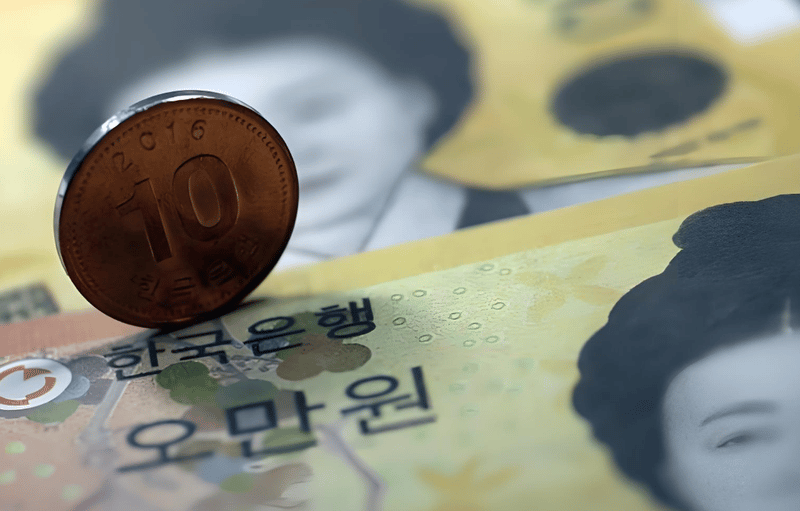
Holiday Return Pressures the Korean Won
After Korea's week-long public holiday, the market reopens facing significant dollar pressure. The Korean won fell to 1,424 against the dollar during the session, marking a new low since mid-May, with a daily decline reaching 1.3%. Traders pointed out that the external volatility accumulated over the holiday period was released in a short time, intensifying downward pressure on the won.
The Dollar Maintains a Strong Position
The core reason behind the won's decline is the continued strength of the dollar. Recently, weak U.S. economic data should have suppressed the dollar, but amid rising geopolitical risks and increased market demand for safe havens, the dollar remains near a two-month high. Analysts indicate that global funds prefer to flow into dollar assets, highlighting the "safe haven effect" that reinforces the dollar's dominant position.
Political Risks Amplify Safe Haven Demand
Global political uncertainty also impacts currency market trends. Whether it's the political stalemate in Europe or the geopolitical conflicts in the Middle East, investors have increased their allocation to the dollar. In contrast, emerging market currencies like the won are more susceptible to adjustments in funds, amplifying short-term volatility.
Characteristics of Korean Market Capital Flows
On the first trading day after the holiday, foreign capital showed clear signs of withdrawal. Institutional data indicates some international investors opted to reduce their holdings of won assets in favor of the dollar and U.S. Treasuries. Meanwhile, local investors remained cautious, with a rising tendency to observe. These changes in capital flows intensified the won's volatility, putting pressure on its short-term performance.
Technical Factors and Psychological Barriers
From a technical perspective, the USD/KRW quickly hit a near five-month high after breaching the 1,420 line. The market is generally focused on the 1,425 to 1,430 range as a critical resistance level. If the dollar continues to strengthen, further depreciation of the won cannot be ruled out. Some analysts suggest that, psychologically, if the won cannot stabilize at the 1,420 mark, market confidence may be further shaken.
Central Bank Policy Expectations at Stake
The next move of the Bank of Korea has become a focal point in the market. Despite the domestic economy still being affected by both export recovery and inflation fluctuations, if the won remains under pressure, the central bank may intervene rhetorically or adjust policies to stabilize the exchange rate. Industry experts anticipate that, amid the uncertainty of Federal Reserve policies, the Bank of Korea's stance will be more delicate, needing to balance financial market stabilization with maintaining economic momentum.
Regional Market Linkage Effects
The won's depreciation is not an isolated phenomenon. Other Asian emerging market currencies have also shown weakness recently. The renminbi, baht, and new Taiwan dollar have all fallen to varying degrees, indicating a widespread impact of the strong dollar on regional financial markets. Analysts believe that if the dollar's upward trend continues, Asian markets may face greater capital outflow pressures.
Short-term Pressure Remains
Overall, the won's rapid decline after the holiday reflects the market's concentrated digestion of the dollar's strength. Safe haven demand, political risks, and capital flows have all increased the downward pressure on the won. In the short term, the won's trajectory will still heavily depend on the dollar's strength and external risk developments, while the Bank of Korea's response strategy will become an important observation point for the future market.