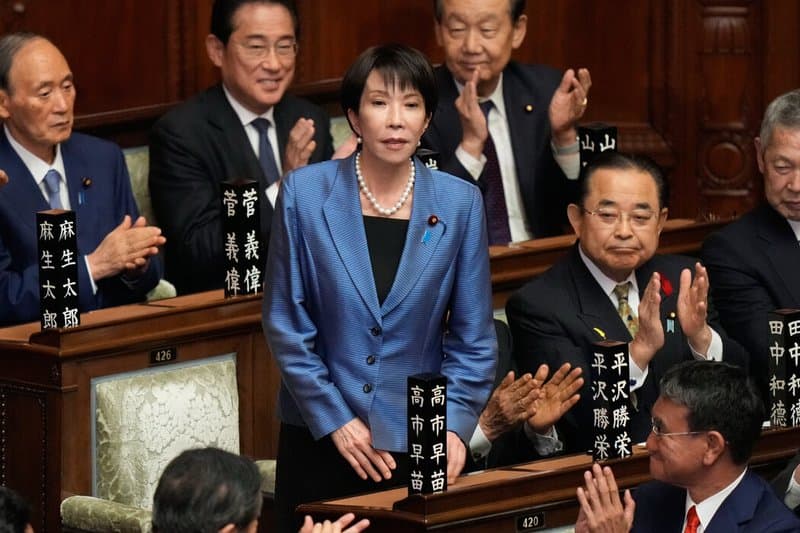
Sanae Takaichi Takes Office, Japan's Policies Undergo Comprehensive Restructuring
Japan's first female Prime Minister, Sanae Takaichi, has officially taken office, rapidly becoming a focal point of global attention. Her ascendancy not only signifies a shift in Japan's political landscape but also heralds a potential simultaneous shift in fiscal and monetary policies. On the eve of Trump's visit to Japan, the nation's policy movements are gripping the nerves of global markets.
Analysts point out that Takaichi's government faces threefold challenges: soaring inflation pressures, unstable export momentum, and the risk of expanding fiscal deficits. The "responsible proactive fiscal policy" she proposed is viewed as a variant of Abenomics, emphasizing government leadership while stimulating the economy. The market generally perceives that the new cabinet's primary task is to balance growth with debt and avoid an imbalance between fiscal expansion and monetary tightening.
Exports Rebound but Risks Persist
Latest trade data shows that Japan's exports grew by 4.2% in September, ending four consecutive months of decline, largely due to the yen's depreciation and strong demand from Asian markets. However, exports to the U.S. continue to contract, with a year-on-year decrease of 13.3%, notably in automobiles and chip equipment.
Despite tariff reductions under the new Japan-U.S. trade agreement, most manufacturers are forced to compress profit margins to absorb rising costs to maintain market share. Economists warn that if exchange rates correct or external demand weakens, Japan's export advantage could quickly erode. Weak export profits might also affect corporate salary negotiations next year, undermining consumer support.
Minoru Nanbu, of the Norinchukin Research Institute, noted: "Companies have yet to fully pass on cost pressures to buyers, making the foundation of the export recovery fragile. If inflation remains high, the export sector will face greater profit pressure."
Rising Rate Hike Expectations, Central Bank Faces Dilemma
As Takaichi takes office, the policy outlook of the Bank of Japan becomes a market focus. A latest Reuters survey shows that over 90% of surveyed economists believe the Bank of Japan will raise interest rates in the coming months, possibly hiking policy rates by 25 basis points as early as October or December.
Though Takaichi is seen as a proponent of fiscal expansion, most analysts believe she will not intervene in the independence of monetary policy. The Bank of Japan Governor Haruhiko Kuroda recently stated that as long as corporate spending and wage growth show resilience, the central bank will consider gradually exiting its ultra-loose policy.
Kento Minami, an economist at Daiwa Securities, said: "The Bank of Japan's policy committee has clearly shifted towards a hawkish stance, and current rate hike expectations reflect market concerns about the persistence of inflation." However, he also noted that if fiscal stimulus exceeds expectations, the central bank may be forced to delay actions to prevent disrupting bond market stability.
Deeper U.S.-Japan Interaction, Dual-Track Political and Economic Advancement
With Trump's return to the White House and first visit to Japan, U.S.-Japan relations have once again become the core of East Asian strategy. The Takaichi government plans to propose large-scale procurement agreements during the meeting, including purchases of American pickups, soybeans, and liquefied natural gas, to demonstrate a commitment to bilateral cooperation.
While Trump demands that Japan bears more defense spending, Takaichi focuses on economic reciprocity to maintain the allied relationship. Diplomatic observers believe this strategy aims to balance external pressure with domestic political demands. The Japanese business community generally welcomes stable U.S.-Japan relations but worries that the new procurement plans might increase fiscal burdens.
Stimulus Plan Poised for Launch, Market Reaction Cautious
Reports suggest that the Takaichi cabinet is brewing an economic stimulus plan totaling over 13.9 trillion yen, aimed at mitigating inflation impacts and promoting emerging industries investment. The plan is expected to cover energy subsidies, tax reduction policies, and investments in artificial intelligence and semiconductor fields.
Although the market has reacted positively to the scale of the stimulus plan, with the Nikkei index rising and the yen exchange rate stabilizing, analysts caution that Japan's debt-to-GDP ratio has already exceeded 260%, and a new round of spending might further weaken fiscal discipline.
Shigeru Nagai from the Oxford Economics Institute noted: "The Takaichi government's policy focus is on stable growth, but fiscal sustainability will become the biggest challenge." If rate hikes and expansionary spending proceed simultaneously, rising debt costs may trigger new market volatility.
Outlook: "Yen Test" Amid Rate Hikes and Fiscal Resonance
Overall, Japan is at a critical turning point for policies and markets. Takaichi's political decisions and the monetary path of the Bank of Japan will determine the yen's trajectory in the coming months.
Analysts believe that if the central bank raises rates as expected and fiscal stimulus is launched simultaneously, the yen's volatility will rise significantly in the short term. Regardless of the outcome, Japan is heading towards a new "policy repricing cycle," which will profoundly impact its status in the global economic landscape.