What is an Activist Investor?
An activist investor buys a significant minority stake in a publicly traded company to change how the company operates. The goals of activist investors can range from advising the company’s management to pushing for strategic actions such as sales, asset divestitures, restructuring, or even changes in the board of directors.
Unlike private equity firms that buy and restructure companies for profit on resale, activist investors rarely purchase all or most of a company's shares. They leverage public communications and private discussions to gain the support of other shareholders and insiders. If these efforts fail, they may launch proxy battles to elect new directors and force the company to comply with their demands.
Key Points
- Activist investors buy minority stakes in public companies to influence their operations.
- If unable to persuade the company's management, they may launch proxy battles to gain board seats.
- Some hedge funds specialize in activism, and institutional investors may occasionally participate.
- Activist actions can focus on maximizing shareholder value or the company's social responsibilities.
- The U.S. Securities and Exchange Commission (SEC) has proposed stricter disclosure rules for activist investors, criticized for potentially making activism unprofitable.
Understanding Activist Investors
Activist investors are sometimes called shareholder activists, a term also used to describe those lobbying for better working conditions for contractors' overseas workers, or supporting opposition board elections to combat climate change.
However, many activists aim to maximize shareholder value, with much of the work done by hedge funds specializing in public pressure, behind-the-scenes lobbying, and business expertise.
Unlike public pension funds and mutual funds, which sometimes engage in activism, activist hedge funds often hold highly concentrated stakes and use derivatives such as stock options to gain additional leverage, offsetting the enormous costs of such investments. Institutional investors may turn to activist strategies only after holding disappointing investments for years, whereas activists typically call for change shortly after acquiring shares in underperforming companies, seeking profits from subsequent turnarounds and stock price increases.
Compared to institutional investors, activists are more willing to use adversarial tactics, from hostile letters to management to scathing public reports, to proxy battles seeking to unseat current directors. (Note: The rise of activist investors is described as an effective market response to the issue of management's opportunity and means to benefit at shareholders' expense.)
Do Activist Investors Ever Reach Settlements with Companies?
Yes, since activism is not a zero-sum game. Given their shared interest in the company's success, activist investors and incumbent managers sometimes reach mutually agreeable compromises. These agreements often grant activists board representation in exchange for supporting management and board nominations for a specific period. The agreements might also require specific actions by management and include clauses preventing activists from increasing their holdings or requiring them to maintain a minimum stake for a set time.
Do Activist Investors Create Value?
Activist investors can sometimes effectively address agency issues faced by shareholders, whose interests do not always align with entrenched management teams. It’s hard to categorize activists as wholly good or bad. They mainly focus on strategies to increase stock prices in the short term, such as returning capital to shareholders via dividends or stock buybacks, which might hinder necessary long-term investments by the company.
Who Are the Largest Activist Investors?
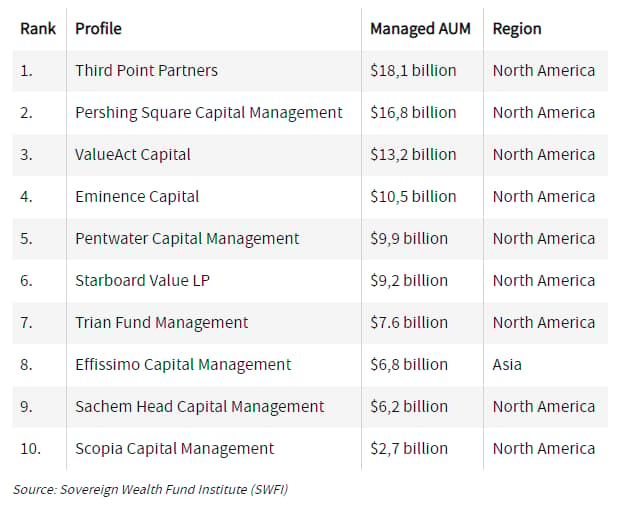
As of the first quarter of 2023, the largest activist investors by assets under management (AUM) are listed below. New York-based Third Point Partners is currently the largest:
Here are the largest activist investment firms by AUM (Q1 2023)