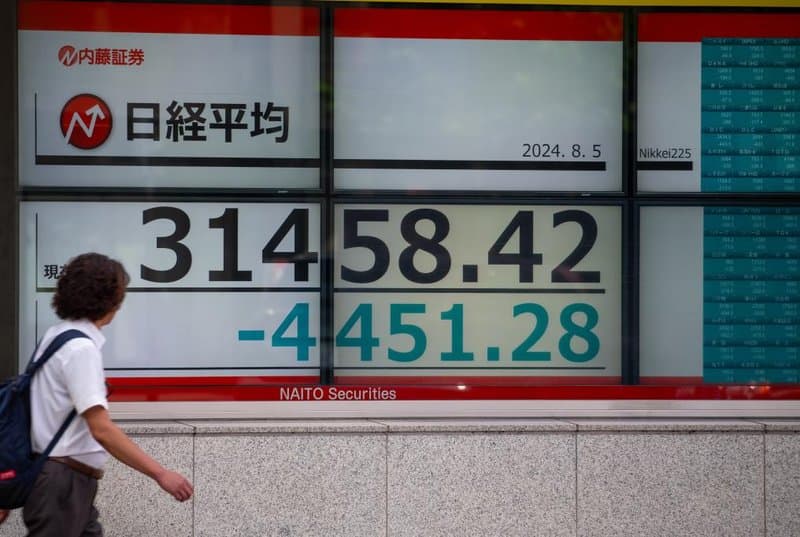
Nikkei and Kospi Set New Records
On Monday (October 28), major Asian stock indices surged, with the Japanese and Korean stock markets capturing global investors' attention once again.
The Nikkei 225 index on the Tokyo Stock Exchange broke the historic 50,000-point mark for the first time, reaching an intraday high of 50,089.27 points, a gain of 1.6%. Meanwhile, the Seoul Composite Index (Kospi) also crossed the 4,000-point threshold for the first time, marking a new era for the Korean stock market.
These landmark breakthroughs highlight the resilience and attractiveness of Asian capital markets amid the global economic recovery. Analysts point out that the strong performance of semiconductor and export-oriented technology stocks is the core driving force behind this rally.
Japanese Stock Market Reaches Record High, Investor Confidence Soars
The Nikkei 225 index has risen over 28% since the beginning of the year, becoming one of the best-performing major indices globally.
Investors generally believe that the continuous improvement in corporate profits, the weakening yen, and large-scale inflows of foreign capital are the three main reasons driving this surge.
Kenichi Takahashi, chief strategist at Tokyo's financial analysis firm SMBC Nikko, stated: "The Nikkei's breakthrough of 50,000 points is not just a numerical milestone, it reflects structural market reforms. Improvements in corporate governance, stronger shareholder return policies, and the Bank of Japan's stable policies have jointly propelled this historic moment."
The recent announcement of a new round of economic stimulus plans by the Japanese government has also boosted market confidence. Analysts point out that with rising corporate earnings and ongoing buybacks, the upward potential for the Nikkei index is widely optimistic.
Korean Stock Market Achieves Historic Leap, Tech Giants Lead the Surge
Meanwhile, the performance of the Korean stock market has been equally impressive. The Korea Composite Stock Price Index (Kospi) broke the 4,000-point barrier intraday, hitting a record high.
The market's focus is on the semiconductor sector, with Samsung Electronics' stock price rising more than 2% and SK Hynix soaring 3%, both setting new records.
Seoul analysts believe this surge reflects strong global demand for memory chips and artificial intelligence hardware. As the construction of AI servers, autonomous driving, and data centers accelerates, the Korean semiconductor industry is ushering in a new profitability cycle.
Hana Financial Investment analyst Lee Jae-hoon pointed out: "Korean export data has grown for two consecutive months, showing a solid recovery trend in the semiconductor industry. The Kospi breaking 4,000 points is the market's collective pricing of this trend."
Capital Flows Back Into Asia, Global Investors Increase Holdings
Amid intensified expectations for US Federal Reserve rate cuts and slowing economic growth in Europe and America, international funds are accelerating their flow into Asian markets.
Bloomberg data shows that since October alone, the net inflow of foreign capital into the Japanese and Korean stock markets has exceeded 18 billion dollars, more than double that of the same period last year.
Analysts point out that compared to the high valuations and growth bottlenecks in European and American markets, the price-performance ratio of Asian tech and manufacturing sectors is more attractive.
Goldman's head of Asia market strategy stated: "Amid controlled inflation and continuous profit recovery, the Asian stock market has structural advantages for medium-term rises."
Market Risks Persist, Investors Remain Cautiously Optimistic
Despite the optimistic market atmosphere, analysts warn that the rapid rise of the Nikkei and Kospi might trigger short-term correction risks.
Some institutions are concerned that the Bank of Japan may adjust monetary policy before the end of the year, causing the yen to rebound and weakening the advantage of export stocks. Meanwhile, Korea needs to focus on the global technology demand cycle and geopolitical risks.
Morgan Stanley's latest report states: "Current valuation levels reflect highly optimistic growth expectations. Should external risks intensify, short-term funds may take profits."
Asian Capital Markets Enter a New Stage
Regardless of short-term fluctuations, it is widely believed in the industry that the joint new highs of the Japanese and Korean stock markets signify that Asian capital markets are entering a new stage.
The convergence of technological innovation, regional supply chain restructuring, and policy reforms provides a foundation for sustained growth in the region.
As Japan's Nikkei News commented: "50,000 points is not just a number, it is a symbol of economic confidence in Japan."
And Korea's Daily Economic pointed out: "Kospi breaking 4,000 points signifies that the Korean market is transforming from a manufacturing-based economy to an innovation-driven one."
In the context of the ever-changing global economic landscape, the performance of the Tokyo and Seoul stock markets undoubtedly injects new confidence and vitality into Asian capital markets.