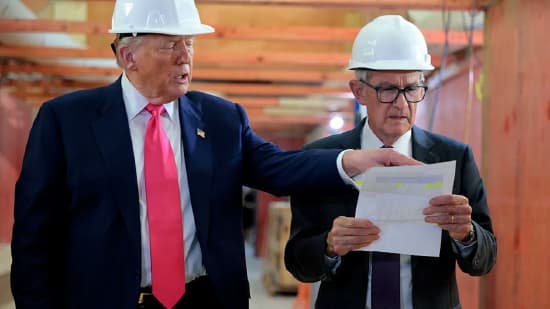
Rare "On-Site Confrontation" Between the White House and the Central Bank
In July 2025, U.S. President Trump and Federal Reserve Chairman Powell engaged in a rare public confrontation in Washington at the Federal Reserve headquarters renovation site. They debated project costs and interest rate policies, drawing significant media attention. This visit was not just a symbolic appearance; it was interpreted as Trump's continued pressure on Powell to push for monetary easing.
Wearing hard hats, the two exchanged words on cost issues, with restrained language yet obvious tension. Trump bluntly stated that the renovation project cost was as high as $3.1 billion, implying chaotic budget management; Powell immediately responded that the president's data was incorrect, mixing in the costs of other projects.
Interest Rate Topic Becomes Focus Again as Trump Hopes for a Rate Cut
Although the event was originally focused on construction projects, Trump did not hide his dissatisfaction with interest rate policy. In response to a journalist's question, he clearly stated his hope that Powell would cut interest rates to address current economic uncertainties. This statement once again demonstrated Trump's strategy of public pressure.
However, Trump also emphasized that he would "not dismiss Powell," contrasting with previous discussions of removal. Sources reveal that although the president is still dissatisfied with the current policy path, he is temporarily refraining from personnel changes due to political and legal risks.
Renovation Project Becomes Focus Amid Cost Dispute
On the surface, Trump's visit was an inspection of the renovation of two Federal Reserve office buildings. He pointed out that the current budget has "far exceeded expectations," implying poor fiscal management. But Powell quickly corrected, stating that Trump confused it with another earlier completed building project.
After a brief exchange, Trump stated he would "investigate the figure thoroughly," but did not specify whether any subsequent administrative or budget audit measures would be taken. This event also brought more public scrutiny to the Federal Reserve's fiscal transparency and project oversight.
Officials' Attendance Sparks Political Speculation
Accompanying Trump were Senators Tim Scott and Thom Tillis, as well as several federal and local construction and financial management officials appointed by Trump. This high-level appearance led to speculation that it might lay the groundwork for public opinion for the 2026 budget approval and financial regulatory reform.
Analysts believe that this visit not only holds symbolic significance but also reflects Trump's strategic coordination on fiscal, monetary, and infrastructure policy issues. By juxtaposing the interest rate issue with the construction cost dispute, Trump aims to shift the "inflation responsibility" onto the central bank, setting the stage for future electoral policy positions.
Powell's Firm Stance and Central Bank's Independence Scrutinized
Despite facing public pressure from the president, Powell remained composed and restrained, avoiding excessive policy responses on-site. He only emphasized that the policy path would be determined by data, without directly addressing whether immediate rate adjustments were considered.
This incident highlighted the fragile boundary of the Federal Reserve's independence under political pressure. Public opinion generally holds that even though Powell has had several disagreements with Trump during his term, his adherence to a "data-driven" policy philosophy remains unshaken, with top Fed officials still inclined to maintain a cautious pace under external pressure.
Policy Interactions to Become Market Indicator
Amid the current slowdown in economic recovery and global inflation decline, the policy interaction between Trump and Powell is increasingly becoming a market indicator. Although the president has not explicitly pushed for personnel changes, his ongoing pressure on the interest rate issue may prompt the Federal Reserve to enhance external communication in the coming months to stabilize expectations and its image of independence.
As elections approach, monetary policy has inevitably entered the political spotlight, and how the Federal Reserve responds next and withstands pressure will determine the future direction of U.S. financial policy.